20 October 2013

Up to date pruning techniques

During Sue's latest trip to the U.K., she went to a lecture on pruning at one of the nearby nurseries.  She compiled what she felt was useful to our members and added some of her own comments.

Quote:

9th October 2013

PRUNING  BY  MATHEW  WILSON,  MANAGING  DIRECTOR  OF  CLIFTON  NURSERIES,  LONDON  (2nd October 2013)

Why prune? * improve fruit and flower production
• remove dead or damaged branches
• plant too large for location
• create topiary


Tools: secateurs (anvil = l stationary + 1 cutting blade)
Parrot clippers
Wetstone to sharpen blades

Anvil secateur

Parrot clippers

Felco Wetstone

Sharpening tools: sharpen bevelled edge only (push downwards and away from body).
Check edge sharpness by holding blade up to good light (if flat it is sharp).


When to prune: immediately after flowering so as not to prune next year’s flowering shoots
OR in spring after frosts i.e. not in autumn.
Prune on a cloudy day


After pruning: feed with compost and water well


DO  NOT tidy up perennials in autumn (do this in spring)
DO  NOT cut off Agapanthus flowers


ROSES
Rose (rambler): Identify = lots of stems from base
Example = Rosa filipes 'Kiftsgate', 'Kew Rambler', Rosa banksaie (my double white Banksia had no flowers in spring 2013 – due to long cold spring).

Rosa filipes 'Kiftgate'

Pruning = remove dead and old wood after flowering.

Rose (climbing): Identify = sprouts from single stem
Example = Rosa Madame Alfred Carriere, Cecile Brunner and Iceberg.


Madame Alfred Carriere

Feed in spring
Train horizontal to encourage vertical growth
Prune from October - Spring.


Rose (floribunda): cut to ground in late winter to 3rd outward facing bud from ground


Rose (shrub): aim for open goblet shape


Cut dead/damaged/diseased/weak branches (to reduce blackspot).


Lavender: prune when still in flower to avoid cutting next year’s flowers (as per Norfolk lavender farmer)
(needs 8 hours of sun per day and light soil)

Buddlea, Lavatera: prune in autumn by one-third all over to reduce wind-rock.

Vines: spring spur prune
Summer remove leaves around grapes.
Remove one-third of all bunches of grapes.

Dogwoods: Cornus sanguinea 'Winter Beauty' (light prune)


Cornus alba (can be hard-pruned by1/3rd each year)


Camelias: prune immediately after flowering in the Spring, flowers on new growth (can prune hard).  Flower buds from in the Summer, so pruning later will remove flowers for next year.    Also, extremely important that they are given plenty of water (in our climate) as flower buds are developing.

Hydrangeas: remove flower heads in late spring

Trachyspernum jasminoides :

 prune in late summer.

Unquote.


22 September 2013

How to make your own fertiliser from sheep manure

At our last garden group meeting we discussed various ways of making our own fertiliser.  I mentioned making it from nettles, comfrey and horsetail.  Details on how to make this fertiliser can be found on our Seasonal Foraging blog

Mary Moore mentioned at the same meeting that her husband makes liquid fertiliser from bags of sheep manure and used washing machine water (grey water).   He mentioned that there is nothing scientific about the quantities.  When the water in the black storage bins starts to look clear, he dumps another litre of so of the fumier into it.  That is usually good for four or five washes or so - about 250 litres.

It is only used for plants in the ground and mainly for hedges in places where he wants to encourage growth.  It is not suitable for plant pots, mainly because of a build up of the soap ingredients which are present in the grey water.

The following steps are how this is done:

  • Here you can see the pipe from the washing machine going into the bin in the garage.  The pump in the bin transfers the water to the outside bins via the yellow hose:-


  • The outside bins (with fumier de moutons) being filled via the hose:-

  • To take the water to the garden old plastic containers are used.  Here they are being filled via a funnel:-

  • Ready to go with six containers on a trolley (diable), built by Mary's husband:-

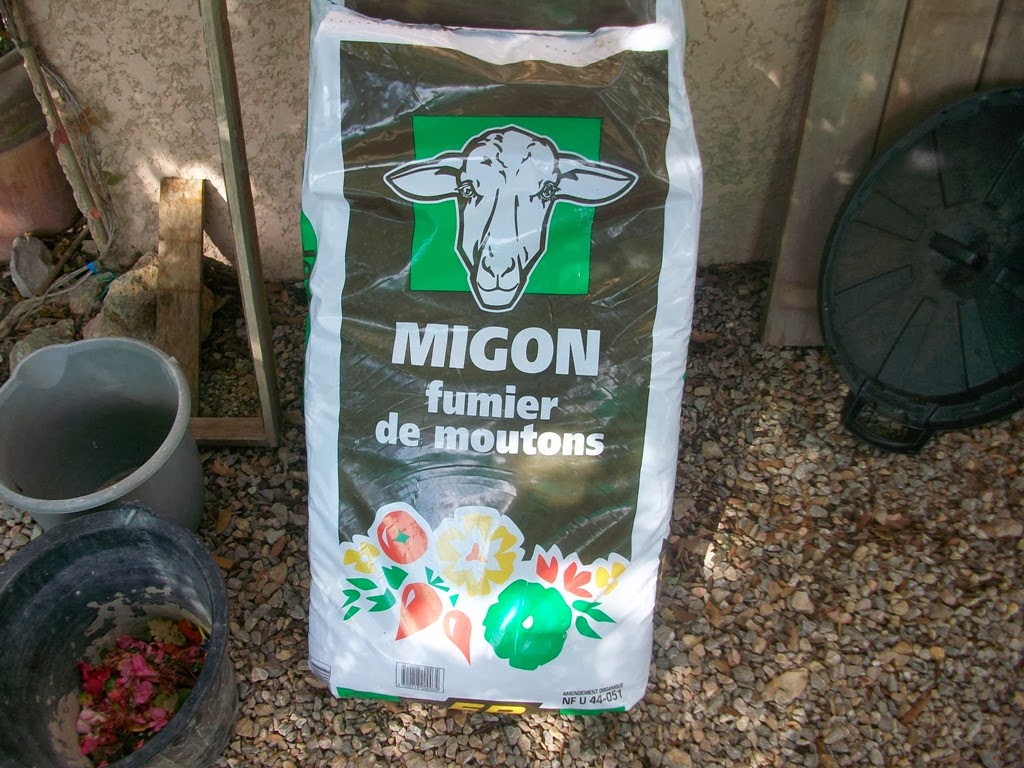
  • Fumier de moutons, 50 litres, 28 Kg, 5.50 € (approx.) from Cooperative in Lorgues:-


11 September 2013

Salvia


There are about 900 species of Salvia.  They are divided into two parts of the world - the  Old World - Salvias from Europe, Asia and Africa and -  the New World - Salvias from the Americas.

Old World Salvias

The colours are more subdued,  of pink, blue and purple.  They are sub-divided into 3 Groups.

Group 1:   Salvias with foliage that form a basal rosette or clump, from which the flowering stem arise.  They flower in early summer with repeat flowering if pruned.

Salvia’s belonging to this group are Salvia pratensis (Meadow Clary).


When you visit the Vaucluse in July you see field after field of  Salvia sclarea (Clary Sage) grown for the parfume industry.


Group 2
Salvia officinalis (Common Sage) with its cultivars belong to this group.

Group 3
Salvia verticillata, a very common Salvia in our area, growing on the side of the road.


as well as a the well known Salvia frequently grown in the gardens of northern Europe, Salvia nemerosa


Apart from the Common Sage, that is used in cookery and medicinally, the Salvia’s we notice most of all are the ones from the New World.  The colours are so bright, flamboyant, Mexico alone has 312 species.


New World Salvias

They again are sub-divided into 3 Groups.

Group 1:   Salvias from the USA.  Many of them from the arid regions of California.  In their native area they flower after the winter rain and are dormant in the summer.

Group 2:   Salvias from Texas, Arizona, New Mexico, continuing into Mexico.  They are half-hardy and many of them do well in our climate.  The most well-known of this group are the shrubby Salvia greggii and Salvia microphylla and the grey leaved, blue flowering Salvia chamaedryoides


Salvia greggii and Salvia microphylla are closely related and it is quite difficult to differentiate between the two species.

Salvia greggii has small, elliptic, glabrous, leathery leaves with entire margins.  The flower colour ranges from white, light yellow to deep orange, purplish red and reddish pink.


Salvia microphylla leaves are pale green, ovate to elliptic, larger than the leaves of Salvia greggii, slightly hairy with serrated margins.  When crushed the leaves smell of blackcurrant.  Colours range from pink to deep red.


Salvia greggii, Salvia microphylla and Salvia chamaedryoides are easy to buy.  Pepiniere ‘Armalette’ in Sillans la Cascade has a large selection of Salvias.

They can get very straggly at the end of the season.  Isabelle, one of our club members, is very successful with her Salvias.   Her advice is to prune them in early spring to a couple of inches above the crown, after their first flush of flowers prune them again but not so low as in early spring, but down to about 25 cm, they will get another flush of flowers in autumn, then leave them un-pruned till late winter.  Feed with general purpose fertilizer before new growth begins.
Best time to plant is in spring.

Group 3:  The Salvias in this group are the most striking of all.  Unfortunately many of them are quite tender and unless taking into a greenhouse will not survive the winter or die down during the winter and come up again in spring.  They are native to the more tropical areas of Mexico, Central and South America.  Most of them are large, bushy perennials and although they are perennials, quite a few of them are grown as annuals in northern Europe.

In their native habitat they grow in forests or in shady conditions, because of this they need humus added to their soil when planting and require watering in very hot or dry periods.

We have  seen several of them whilst visiting gardens on the coast.  In William Waterfield’s garden, right in front of the house was growing the blue-black flowering, Salvia discolor.


One of the very pretty Salvias in this group is Salvia guaranitica,


in spring it should be cut down to just above ground level.

On a garden visit to Mr Cuche’s garden in Claviers we saw Salvia leucantha.


One of us bought the plant and this year I was given a rooted cutting.   I’ve planted it in the garden, it has become quite big, but no flowers yet.  During the winter I’m going to cover it with leaves and then cover the leaves with chicken wire to keep the leaves in place.   As with most Salvias this plant can get a bit messy.  As it is principally an autumn flowering plant, the spent flower heads can be pruned back, but the actual pruning should not be done till spring.  Prune back to the new growth.

An other well-known one is Salvia farinacea, it dies down every winter, but comes back again in the spring.


Salvia ‘Indigo Spires’, very popular cultivar at the moment flowers all summer, again this one dies down in winter but comes up in spring.


Salvia patens with its beautiful blue flowers can be treated like Dahlia tubers.  The tubers are lifted and stored in a dry place to be planted out in spring.


Salvia elegans (Pineapple Sage), an autumn flowering Salvia, with scented leaves and bright red flowers is best stored in a frost free place during winter and pruned to just above soil in spring.  If left in the soil here in a protected place it will die down and come up again in spring.


Bibliography:  Salvias books I & II – Christine Yeo

26 June 2013

The Navarro's Succulent Garden - La Garde


At the request of several members we returned to Monsieur and Madame Navarro's incredible garden at La Garde, near Toulon. When the sliding gates open off the busy road you enter a very different world of exotic cactis and succulents. 


This part of the garden is only 8 years old


These plants are intermingled around the well established garden which also contains the usual oleander, salvias, geraniums etc we see in most people's gardens in this part of the world. 


Crinum


Artichoke


Convolvulus mauritanicus


Calliandra (Powder Puff Tree)

They have over 400 different varieties of  agaves 


Agave stricta

and over 2000 pots of the more tender plants dotted around the garden and several greenhouses filled with exotic succulents.


Hoodia bainii


Kalanchoe beharensis


 The plant in the pot with the red flower is a Senecio stapeliformis, quite different from the common silverleaved, yellow flowering Senecio's

The pots are all taken inside in the autumn to protect them from frost. Watering takes several hours every day. The southern extremity of the garden has a huge bamboo hedge which creates an impenetrable barrier and a cool feeling. They originally started with three plants so beware! 


Podophyllum kaleidoscope


This charming couple have devoted over 40 years creating a garden like no other in 6000 square meters. Originally a vineyard the land is bound on one side by a river and when that runs dry in May they turn to their well for watering and when that runs dry they have a green meter for watering the garden. Apparently everyone can apply to their Mairie for one of these meters and  the water is cheaper.  Three times a year they mulch the garden with several lorry loads of local chippings.


Trevisia palmata

We learned that succulents and cactis are part of the same family but not all cactis are succulents. The most tender plants are kept in a green house that is never allowed to fall below 14c.


Caudex collection, roots grow above the soil


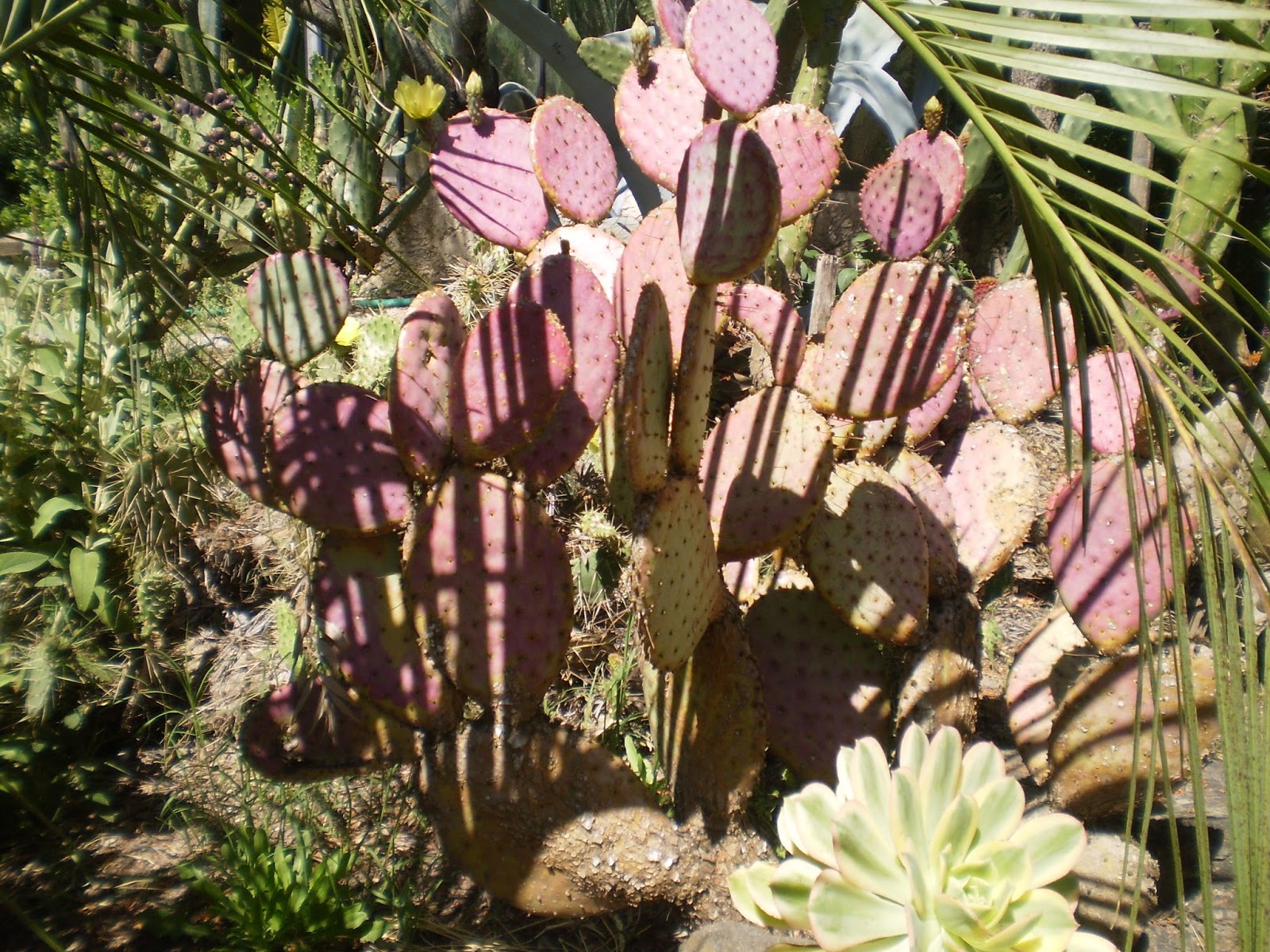
Opuntia 'Santa Rita' cactus, the more sun it gets the redder the pads

After wandering round the garden we sat in the shade of a large mulberry tree and shared a delicious picnic lunch. 


Afterwards Madame Navarro gave us coffee and homemade fig and apricot tartlets.


They also asked us to help ourselves to pots of succulents in their nursery.


They are such a charming and unassuming couple and their garden is testament to their passion.


Text:  Michele Power
Photos:  Gerda Nagtegaal; Marie-France Parks; Michele Power

LinkWithin

Related Posts Plugin for WordPress, Blogger...