Showing posts with label pests. Show all posts

19 October 2012

A serial killer in our garden : Paysandisia archon


This pest native to South America, Uruguay, Paraguay, central Argentina has been accidentally introduced to Europe in the 90’s. It can be found in Spain, Italie. In France all the departments of PACA (Provence Alpes Côte d’Azur and Languedoc Roussillon are affected; now it is spreading to South West of France. 

 The scientific name for this moth is Paysandisia archon it belongs to the family Castniidae (Lepidoptera), most members of which live in South America where it is not consider as a pest. The adult is a beautiful moth, with a large wingspan of 9–11 cm. The fore-wings are olive brown-colored and the hind-wings are brightly colored with red, black and white The antennae are clubbed. Females are a little larger than the male. The eggs are laid separately; they are oblong (5 mm long), cream-colored and with longitudinal ribs. Just after hatching, the larva is pink-colored and less than 1 cm long, but turns white as it grows. It reaches 6–7 cm at the end of its development, looking a bit like a grub. 

The observations suggest that the moth has a long cycle of development. The adults are observed from June to September. They are active during the day. All stages of development, from egg to chrysalis have been recorded at the same time, in July. The egg is laid at the basis of the leaf on the stem or in the terminal bud. The larva bores a gallery through the stem or through the young leaves causing characteristic damage. When several larvae bore simultaneously in the stem, the palm becomes weak and can even die. Except for the period when the adults are flying, it is difficult to detect the presence of the pest; at the larval stage the only sign may be the presence of plugs of debris, like sawdust, visible at the outermost extremity of the gallery. The larva turns into a chrysalis, protected by a cocoon made with palm fibers inside the gallery. At the very end of its development, the chrysalis frees itself from the cocoon at the outermost extremity of the gallery, and a new adult moth is born after tearing this envelope. The remains of the chrysalis are often attached to the exit hole of the gallery for a while. 

Damage 
 The damage is observed at different levels of the tree: leaves, rachis and top of the stem. Once hatched, the larva bores towards the heart of the palm and if several larvae are present on the same tree, this can lead to the death of the palm. Big palms can survive if they are not too severely attacked, but small ones or plants in the nursery or in containers are very exposed to attack. 


 How to treat it 
If the trees are too far gone they have to be destroy them by burning. 
 You can put a special kind of glue on your trees as a preventative measure (it kills the larvae). 
Also there are natural predators, such as the nematode worm.

Bibliographie :

24 March 2010

Ants


Our grandfathers had their own method of dealing with ants. They had to protect their crops, when there were no insecticides available. Nowadays we have many different types of insecticides that deal with ant problems, yet many of us feel we would like to get rid of the ants without using insecticides. Below are a few tips, grandfather’s ways !


The harshest way is on a hot, sunny day to place a clay flower pot upside down over an ant’s nest. Within three to five hours, the ants will lay their eggs in the flower pot, you can observe this via the hole in the flower pot. When filled with eggs, fetch a bucket with very hot water, scoop up the flower pot with a spade and slide it into the hot water.

Another way is to carefully dig out the ants’ nest with a large spade and throw it away with a wide curve. The birds will eat the eggs and the disturbed ant colony will find it very difficult to regroup together again, in fact they may never do so.

A bit more humane is to press into the ant’s nest fresh leaves of chervil, thyme, marjoram/oregano or lavender. They dislike the herby smell and they’ll leave the nest.

The unwanted shoots of the tomato plants is another thing they loath. You press them into their nest and the same thing will happen as with the herbs, they leave the nest. They’ll regroup in another place in the garden but at least not in the spot you found so unsuitable.

A handful or mint leaves, or a teaspoon of dried mint mixed with 25 cl water, then poured onto an ants’ nest is another successful method.

23 February 2010

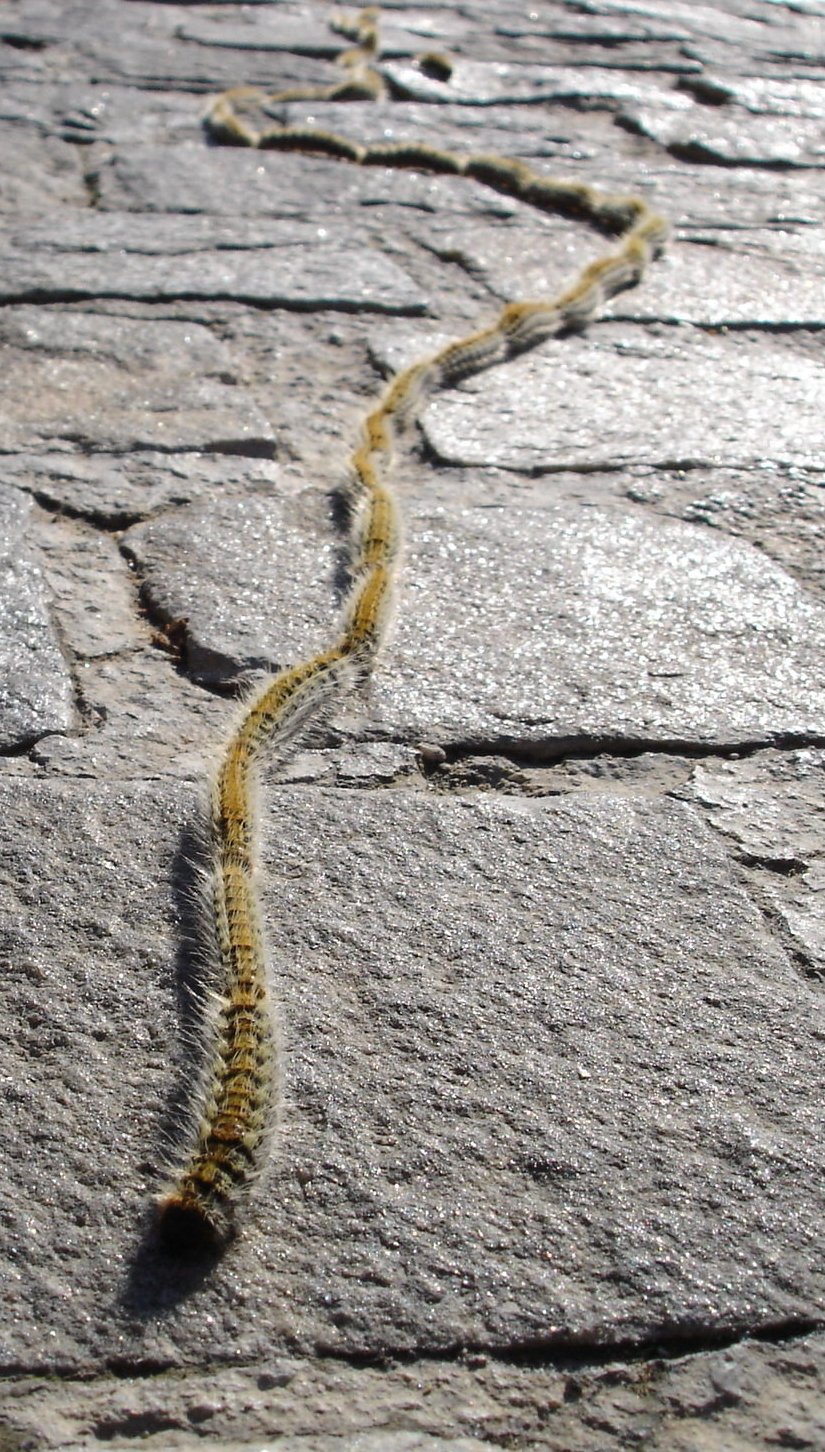
Processionary Caterpillars


Now is the time of year to be vigilant for emerging caterpillars. Late this year because of the prolonged cold weather, they will soon be leaving their cocoon in pine trees to move on to the next stage in their lifecycle. If you see them on the road, try and run over them – obviously making sure you drive safely !

If you are able to reach a nest, carefully remove it by cutting down and burning. [Make sure you burn according to local fire restrictions / regulations] Be aware that even hairs left in old, disintegrated nests can still cause a skin reaction.

[nighttime when they emerge to feed on the sap from the pine needles]

They are extremely dangerous to domestic pets and people as their hairs are extremely urticarious. Any contact with the hairs will cause a severe rash to the skin and if they get into mouth or eyes, you should wash with abundant amounts of water and see a doctor as soon as possible. If you know your cat or dog has had contact – usually through sniffing at them or trying to eat them, again use a shower to rinse the remaining hairs away, especially from the mouth, and get to the vet URGENTLY.

[it didn’t help that the wind was blowing whilst trying to film this !]

The following is from Wikipedia :

The Pine Processionary (Thaumetopoea pityocampa) is a moth of the family Thaumetopoeidae. It is sometimes placed in the genus Traumatocampa. It is an abundant species of pine woods in central and southern Europe.

Traumatocampa pityocampa01.jpg

It has cream coloured forewings with brown markings and white hindwings. The species flies from May to July. The larva is a major forest pest, living communally in large ‘tents’, usually in pine trees but occasionally in cedar or larch, marching out at night in single file (hence the common name) to feed on the needles. There are often several such tents in a single tree. When they are ready to pupate, the larvae march in their usual fashion to the ground, where they disperse to pupate singly on or just below the surface. The larvae should never be handled as the abundant hairs on their bodies cause extreme irritation to the skin.

File:Thaumetopea.pityocampa.01.jpg

References

http://web.cortland.edu/fitzgerald/PineProcessionary.html

LinkWithin

Related Posts Plugin for WordPress, Blogger...