The idea of visiting the "
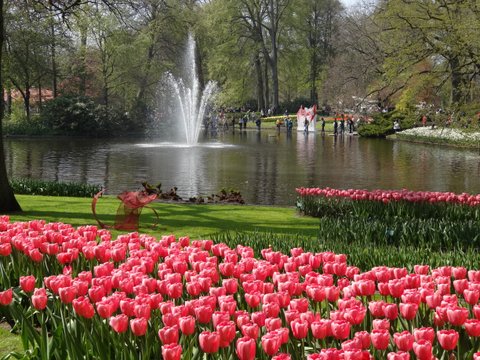
Keukenhof" came after we discussed 'Tulips' as a topic on one of our Garden Group Meetings in 2012. Gerda and I explained to our members that the '
Keukenhof ' is a park near Amsterdam with the largest display of spring bulbs in the world. We then suggested that if there was an interest, we could organise a visit in 2013.
Although the aim of the visit was the '
Keukenhof', to go all the way to Holland just for one day seemed excessive. We suggested that in addition to the 'Keukenhof' we could visit Amsterdam. We were lucky that the largest museum in the Netherlands -
Rijksmuseum - was opening its doors in April after 10 years of restoration. In the end the visit became 4 days, day 1 was the travel day, day 2 was Keukenhof, day 3 was Amsterdam, day 4 was a free day.
As Gerda regularly visits Amsterdam, she was able to gather all the information required, we then discussed the program. All the necessary reservations for the different venues, trams, bus, train, canal tour and restaurants were made by Gerda. It all went very smoothly.
People stayed in different hotels, as we left the booking of the hotels to the individuals. Our agreed meeting place was the main entrance to the
Centraal Station in Amsterdam where Gerda would stand with a red rose attached to a pointer.
The first day we met at 17.30 hrs in front of the Central Station. Gerda then walked with us to the
Nieuwmarkt, where we were going to have our meal at 'Cafe Bern'. It is a typical old fashioned 'brown' cafe, where the walls have darkened due to many years of cigarette smoke, they are left like this to give it ambiance.
We had a very tasty meal. None of us had eaten steak done this way before. The steak was cut into slices and arranged on the edge of a dish. In the middle of the dish was a green sauce.
The dish was placed over a burner, which heated the sauce. You then put a slice of the steak into the sauce and cooked it to your liking. We were all debating what was in the 'green sauce', definitely tarragon, possibly some mint but the rest of the ingredients was a mystery.
After our meal we walked through the 'red light district' to the '
Nieuwe Kerk', where the new king, Willem Alexander, was inaugurated just two days earlier. The inside of the church was open to the public for two days after the event to view the display of flowers. Unfortunately the queue was too long. As we had an early start, we all felt quite tired and were ready to retire to our hotels.
Day 2, we met at 08.45 at the
Centraal Station to take the train to Schiphol. From Schiphol a bus took us to the '
Keukenhof'. In the park everyone went his own way. We agreed to meet at the drop off point at 15.30 hrs.
The park is rather large, 32 hectares. So large that the small group I was with, did not come across other members till the end of the visit. Its design is based on an English landscaped garden.
Apart from the flower displays there are 5 pavilions where one could have a meal. In addition each pavilion had exhibits and small shops.
Every year there is a particular theme in the '
Keukenhof', this year it was Great Britain. There was a display of '
Big Ben' and the '
Tower of London' laid out in flower bulbs. It had to be viewed from above to appreciate it.
We were very lucky with the timing of our visit. As spring was so late this year, the daffodils and hyacinths were still in flower. The smell of the hyacinths and some of the daffodils as one walked along the paths was intoxicating.
Not all the tulips were out, but enough to enjoy the carpet of colours.
7 million tulips, daffodils and hyacinths were planted for 2013. The park is open each year from late March to mid May. It has an amazing array of colours and scents, all set among water ways, lakes and mature trees.
A trip on a boat through the bulb fields was a possiblity, unfortunately when we got to the departure point, they were fully booked. Luckily one could see some of the bulb fields from the Keukenhof.
In the evening we had dinner at a well known fish restaurant '
Sluizer' in the
Utrechtsestraat. I think everyone enjoyed the meal.
It is quite easy to find your whereabouts in Amsterdam. Everywhere in the centre is within walking distance; there are plenty of buses and trams available.
Day 3, we met at 08.30 hrs at the
Centraal Station. We had a group booking for the
Rijksmuseum.
As the museum has just opened, the queues were long. With a group booking we could just go in. We agreed to meet at 12.30 at the same entrance we entered through, for the continuation of our program.
The
Rijksmuseum was opened in 1885. The architect, P.J.H. Cuypers, is the same architect who built the
Centraal Station. In 1813 the Prince of Orange became King (William I) after The Netherlands gained freedom from the French. This was our first King. although the House of Orange dates back to the 16th century and has been governing Holland since that time. To commemorate the occasion it seemed appropriate to build a museum to house all our well known painters.
One of the directors in the past decided to white-wash the walls inside covering the wall paintings. Part of the restoration was to restore the wall paintings to their former glory.
Some of the paintings:
The most famous of all the paintings in the
Rijksmuseum is 'The Night Watch' by Rembrandt. It has prime position at the end of the hall of the old masters.
Johannes Vermeer: The Milkmaid
Jan Steen: The Dancing Lesson
Johannes Verspronck: Girl in Blue
Beside the paintings there are many objects on show- Delft Blue ware, furniture, silver ware etc.
Tulip Vase
We had lunch in the 'Eye' across the
IJ (a sort of lake that divides north Amsterdam from the rest of the city). To get there we had to take a ferry.
Lunch, for most of us, was kroketten
with bread, a Dutch version of fast food.
After lunch we went on an hour-long canal trip. The 3 main canals,
Herengracht, Keizersgracht and
Prinsengracht are lined predominantly with Elm trees, some of them between 80 to 100 years old. After the canal cruise we visited the
Begijnhof.
A
Begijnhof is an enclosed area with houses built around a central court yard. It is closed off, a bit like a convent, by a door. Once through the door you enter into a very peaceful setting, although the
Begijnhof is in the middle of Amsterdam. The women who lived there were called '
Beguines'. They took a vow of chastity, and had to attend mass each day but enjoyed a greater freedom than nuns, they could leave the
Begijnhof to get married. Even today only single women are allowed to live in the
Begijnhof. The yellow flowers in the photo are
Kerria 'Golden Guinea', with very large single flowers.
We then visited what is called 'the nine streets', narrow small streets between the main canals with lots of small shops.
Our last dinner together was at an Indonesian restaurant '
Sama Sebo', where we had ordered a
Rijsttafel.
Sunday was a free day. Most of us were on the Transavia evening flight back to Nice. From the emails we received I think our members enjoyed their stay in Amsterdam and the visit to the
Keukenhof was the high point of the trip, with the
Rijksmuseum a close second.
Photos: A big thank you to Liz Bouttell, Esther Flanaghan, Hazel Francis, Rosemary Halford, Jacquelyn Hodkinson, Gerda Nagtegaal, Cindy Roine, Hilary Smith.