26 February 2010

Roquebrune sur Argens


A Roquebrune sur Argens
du vendredi 5 mars au lundi 8 mars de 9h à 17h vous pouvez vister les serres de Michel Vacherot qui est avec Philippe Lecoufle à Boissy Saint Léger près de Paris l'un des plus grands producteurs et multiplicateurs d'orchidées de France.
La collection d'orchidées est superbe, des visites guidées sont organisées ainsi que des démonstrations de rempotage.
Un bel endroit à découvrir pour ceux qui ne connaissent pas.
CD 7, Le Pont D'Argens
Point GPS 43°27.071 Nord 006°38 Est
83520 Roquebrune sur Argens
04 94 45 48 59

25 February 2010

Repotting Plants

From now, till the end of March, is the best time for repotting indoor or outdoor plants. A few tips :

Choose a pot one size up from the one the plant was in. If you are using a used pot make sure that the pot has been cleaned.
Start off with covering the hole in the middle of the pot with a piece of broken pot or a used teabag.
Cover the bottom of the pot with 3 to 5 cm of gravel or other material (clay pellets/styrofoam etc) to improve drainage.

Put a layer of soil on top of the gravel (the type of soil you choose is dependent on the plant you are repotting, ie. an acid soil for camelias, hydrangeas, etc).

Put the old plant pot into the new pot to have an idea of how much soil you should put in initially, taking into account that you must be able to water the plant comfortably.
Try to loosen the plant by tapping at the bottom of the pot, then gently pull it free, if that does not work, try tapping again, sometimes it may be necessary to cut or break the pot in order not to damage the plant or roots.
Once out of the pot try to disentangle the roots and spread them out when planting into the new pot.
Fill in with soil.
Water it in.
Start giving fertilizer to the plant one month after repotting, continue to give fertiliser till end of September.

Rejuvenating or refreshing pot plants is meant for plants that are already in a large pot and it is really not very practicle to replant them into an even larger pot. Loosen the soil as much as possible around the top and sides without damaging the main root and take the loosened soil away. Fill the gaps with fresh soil. Water it in. Give fertiliser after one month, and continue to do so till end of September.

23 February 2010

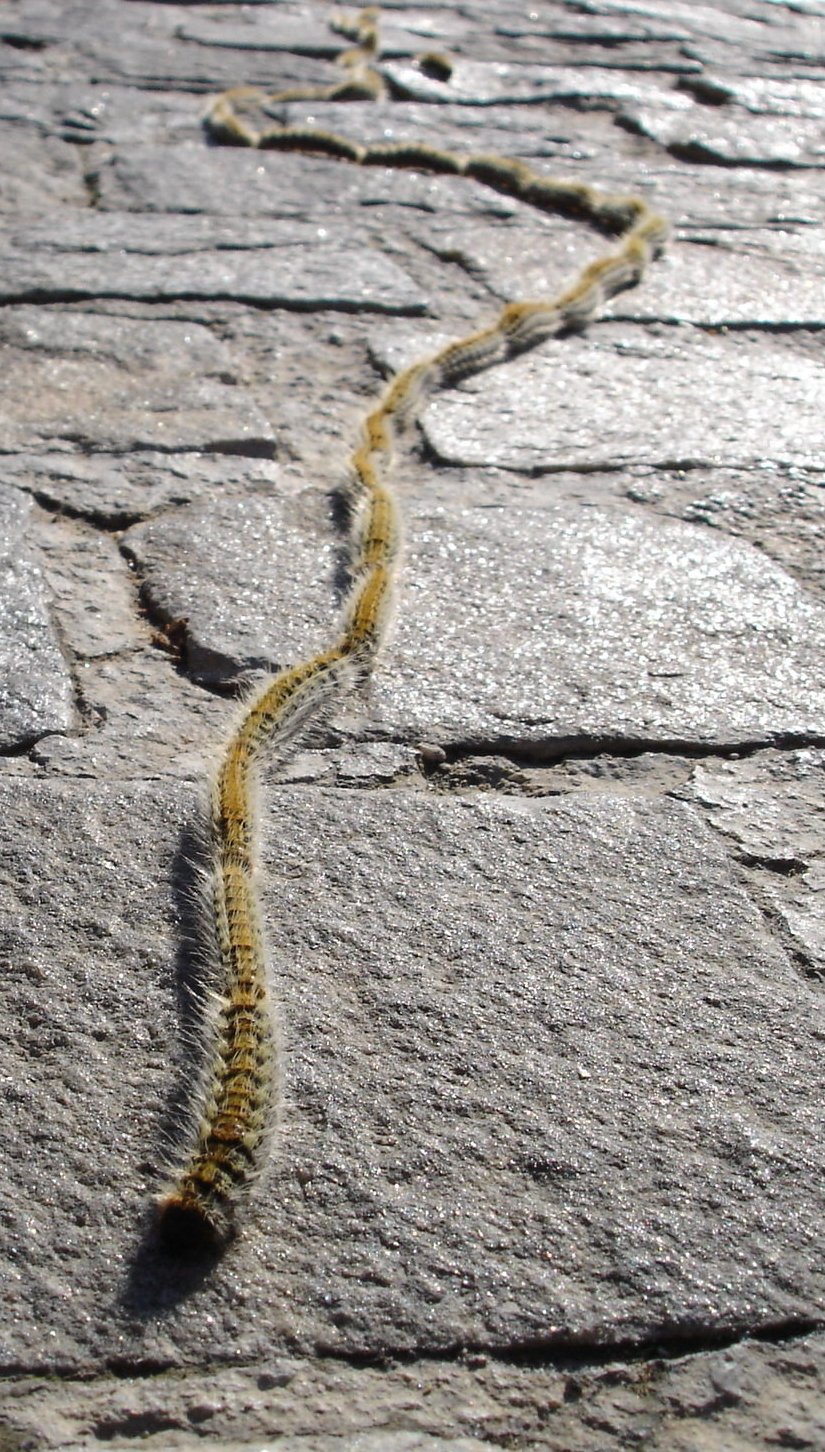
Processionary Caterpillars


Now is the time of year to be vigilant for emerging caterpillars. Late this year because of the prolonged cold weather, they will soon be leaving their cocoon in pine trees to move on to the next stage in their lifecycle. If you see them on the road, try and run over them – obviously making sure you drive safely !

If you are able to reach a nest, carefully remove it by cutting down and burning. [Make sure you burn according to local fire restrictions / regulations] Be aware that even hairs left in old, disintegrated nests can still cause a skin reaction.

[nighttime when they emerge to feed on the sap from the pine needles]

They are extremely dangerous to domestic pets and people as their hairs are extremely urticarious. Any contact with the hairs will cause a severe rash to the skin and if they get into mouth or eyes, you should wash with abundant amounts of water and see a doctor as soon as possible. If you know your cat or dog has had contact – usually through sniffing at them or trying to eat them, again use a shower to rinse the remaining hairs away, especially from the mouth, and get to the vet URGENTLY.

[it didn’t help that the wind was blowing whilst trying to film this !]

The following is from Wikipedia :

The Pine Processionary (Thaumetopoea pityocampa) is a moth of the family Thaumetopoeidae. It is sometimes placed in the genus Traumatocampa. It is an abundant species of pine woods in central and southern Europe.

Traumatocampa pityocampa01.jpg

It has cream coloured forewings with brown markings and white hindwings. The species flies from May to July. The larva is a major forest pest, living communally in large ‘tents’, usually in pine trees but occasionally in cedar or larch, marching out at night in single file (hence the common name) to feed on the needles. There are often several such tents in a single tree. When they are ready to pupate, the larvae march in their usual fashion to the ground, where they disperse to pupate singly on or just below the surface. The larvae should never be handled as the abundant hairs on their bodies cause extreme irritation to the skin.

File:Thaumetopea.pityocampa.01.jpg

References

http://web.cortland.edu/fitzgerald/PineProcessionary.html

21 February 2010

Mimosa


I think most of us would love to plant a Mimosa in their garden. In this post I’ve looked at the most popular Mimosa cultivars on the market. Just as with citrus fruits there are differences between the cultivars and species of Mimosa. Some Mimosas, as we’ve all seen around us, seem to do rather well even in our area. Again it is a question of choosing the right spot (wind-free/sunny) and the right type of Mimosa, one that is more suitable to our region.

A few facts to consider :

1. Mimosas like acid soil, only Acacia retinodes will accept chalky soil, so plant your mimosa in acid soil.
2. There is no need to fertilise, they rather like poor soil and as they belong to the leguminosae family, they release nitrogen into the soil.
3. Prune them after flowering. Not to be bothered by their pods, cut off all the spent flower heads.

A bit of history:

The Latin name for Mimosa is Acacia. Acacia is a genus of around 1200 trees, shrubs, climbers. Their habitat ranges from Central to South America, southern part of Africa, Australia and Tasmania. In Australia and Tasmania alone, there are 800 species.

The Acacia trees that we call Mimosa, originally came from Australia. It was Captain Cook, who brought seeds and plants back with him from Australia. The first Mimosa trees in the UK were acclimatised in Royal Kew Garden.

Between 1830-1850 when some English started building sumptuous villas along the Mediterranean coast between Toulon and the Italian Riviera, they introduced the Mimosa tree to the region.

The first Mimosa introduced to the Alpes Maritimes was the Acacia farnesiana. Acacia dealbata was introduced in 1864 and its cultivars have become the principal mimosas where the cut flower industry is concerned.

The following are the most popular Mimosas.

Hybrids of Acacia dealbata x Acacia baileyana :
Acacia Mirandole (-5C /-7C), A. Mireille (-5C/-7C), A. Rêve d’Or (-5C/-7C), A. Tournaire (-5C/-7C), A. Le Gaulois (8C/-10C), A. Le Gaulois var. Astier (-8/-10C) and A. President Doumergue (-7C/-10C). They are multiplied only by grafting. In the Tanneron region, the Mimosa plantations consist of A. Mirandole (60%), A. Astier (10%) and A. Gaulois (30%).

Hybrids of Acacia decurrens x Acacia baileyna :
A. rustica (-8C/-10C) and A. Bon Acceuil (-9C/-10C).

Acacia cardiophylla (-7C), colloquially (in Australia) called Wyalong Wattle.

Hybrid of Acacia podalyriifolia x Acacia dealbata :
Acacia hanburyana (-4C/-8C), it flowers in great abundance, with grey/whitish leaves.

Acacia floribunda (-8C/-11C), colloquially (in Australia) called White Sally Wattle, has creamy white flowers.

All the above flower in the winter.

Acacia retinodes (-5C/-8C)
Also known as – Mimosa des Quatre saisons – flowers several times a year, principally in spring and autumn. Cultivars of A. retinodes :
A. Guillon, A. Imperial, A. Jean-Pierre, A. Layet and A.Lisette.
Although this mimosa is sensitive to strong winds, as it has superficial roots, it is often used as a rootstock for other Mimosas because of its tolerance to chalky soil.

When I planted my Mimosa Mirandole, four years ago (when I’d just arrived in the south of France), had I known all the above, I would have choosen a different Mimosa. I would have planted it in acid soil and would have chosen a sheltered spot. I did none of the above, in fact I gave my Mimosa a good bit of manure each year. Although the Mimosa has not died, because of its position it needs to be pruned quite a bit each year because of the die back due to wind damage and frost and consequently it has never flowered after the first year.

The National Collection of Mimosas in France is held by Gerard Cavatore, quite near to us in Bormes-les-Mimosas (where else !).

18 February 2010

Citronnier Épineux

Poncirus trifoliata ‘Flying Dragon’

Le Poncirus trifoliata est arbuste très ornemental à feuillage caduc, épineux, il peut servir de haie défensive.

Cette plante tolère la sécheresse et a une grande résistance au froid. Elle peut donc être plantée en pleine terre au soleil ou à mi-ombre. Elle se multiplie par semis ou par boutoures semi-ligneuses (avec hormone de bouturage et de préférence chaleur de fond).

Elle fleurit au printemps, les fruits arrivent à maturité en octobre et ressemblent à des mandarines, la peau parfumée s’utilise en cuisine, le jus également.

A l’automne le feuillage devient flamboyant, rouge orangé. Cette plante est idéale pour la ‘vie avec les animaux’, les épines protègent les oiseaux.

LinkWithin

Related Posts Plugin for WordPress, Blogger...