08 October 2020

Visit to Chateau Saint Roux, Le Cannet-des-Maures, 29th September 2020

The September visit was the first since February – the March, April, May and June visits were cancelled due to lockdown and the club committee’s decision to suspend all club Activities until the end of the club year.   Later, garden group members were canvassed as to whether they wanted their Activity to re-open and of those who responded 75% were in favour.

We were 13 members for the visit to Chateau Saint Roux just south of Le Cannet-des-Maures and the group was split into a morning and afternoon visit to accommodate the “rule of ten” and had lunch in the sunshine on the spacious outside terrace.

The chateau dates from the fifteenth century when the land was bought by an Italian nobleman and the property named for the dark red earth and rocks.   The chateau was acquired in 2015 by British businessman Mark Dixon and is one of his four wine domains in the Var.   After two years of extensive renovations to both the house and various stone granges and gardens the house was opened as an auberge in 2018.

Unusually the garden was created in tandem with building renovations so the planting is no more than five years old (all plants and trees supplied by Pierre Basset, Cogolin) with ancient olive trees planted above ground with surrounding stone wall and underplanted with thyme.   The rose garden to the side of the house is just two years old and a credit to the gardener with their glossy green leaves and vigorously flowering floribunda rose “Iceberg”.   Metal pergola were covered with climbing roses with some “mile-a-minute (roses not in flower, but the “mile-a-minute” was smothered with white flowers). Dwarf pittisporum edged the beds and we were puzzled as to why quite a few of these had dead vegetation in the centre despite having access to the same soil and water conditions.  

The entrance to the deep terrace in front of the house is via a sand path bordered on either side with slightly curved flower beds enclosed with rusted metal edging radiating from the path which is lit by electric lights concealed in rusted mini-bollards (photo below).   The planting here is pure Provençal with a dash of Africa around the stone fountain (tall, sturdy papyrus).    The Provençal mix is a blend of day lilies (flowering again after the autumn rains), gaura, agapanthas, bright red sages – all interspersed with herbs such as thyme and fennel (over two metres high!).   I also spotted some white gaura the same height and wondered what steroids it was on, then remembered the gardener telling me that they used goat manure – always available thanks to the chateau’s herd of 50 goats in the woods.

The walled vegetable garden with metal gates to keep out the wild boar covers 3,800 sq.m.   The planting is in the shape of a leaf with all beds curved and edged in vertical tree trunks/ branches sourced from the woods – there is 4 km of edging !   The vegetables supply the restaurant and during the early summer you can order boxes of vegetables for collection on Fridays.


The gardens are irrigated with a watering system of snaking brown pipes with nozzles for each plant.   The annual work involved in removing calcaire and soil from the nozzles is high maintenance and for those with young knees, nimble fingers and good eyesight !   Three full-time gardeners are employed year round with numbers increasing to five in the autumn for hand-weeding (no weedkillers used) and re-opening the greenhouse (not used during hot Provençal summers) for sowing seeds and potting-up cuttings. 

To oneside of the vegetable garden was a long wide avenue of olive trees underplanted with Stipa tenuissima interspersed with Perovskia.  Unusually Stipa, like Salvia, are best planted in the spring.   On the other side of the potager the slope beside the path to the animals were more olive trees, this time underplanted with Helichrysum italicum.

Circular courtyard through bell tower and arch and in front of Boutique with ancient olive tree underplanted with thyme;  behind brilliant pink gaura flowering its socks off.

The goats were the first animals to arrive as the pasture is well away from the house and the noisy building works.   Cheeses are made on site and sold in the Boutique.   The ducks and geese occupy the large rectangular bassin behind the parking with the hens, guinea fowl, pony, donkey, more goats and four black sows (black Corsican pigs crossed with a French wild boar), behind the dependences.   The sows had just farrowed so two-week old piglets were on show in the morning but most were taking an indoor nap during the afternoon.   The crossbred sows had been mated with a resident wild boar (temporarily re-housed for the safety of the piglets) but again the Corsican DNA won the day and there were only four stripey piglets and the rest were black.

 Ideas to take home :  *   metal edging to flower beds

            *  underplanting large olive trees with thyme or lavender or stipa

            *   pots of ferns massed on open metal hanging frame
            *   bark on pathways (but fine bark needs renewing every 5 years)

            *   massed stipa grasses are more effective than groups of three


27 January 2020

Last meeting of the year at Francoise McCredie, 4 December 2019


The last meeting of the year, as always, is at Francoise McCredie.  For the 4th year running Gillian has introduced us to some of her recipes using Rosemary, Mint and Coriander. We tried them all.

After the cookery lesson we had our tea.  As usual we had plenty of cakes to choose from, all very delicious.

The following are Gillian's suggestions, using Rosemary, Mint and Coriander:

Aromatic Rosemary Infusion

Serves: 1 cup

Ingredients:

2 tbsp. fresh rosemary leaves, or 2 tsp. dried
6-8 oz water

Instructions

If you are using fresh rosemary leaves, chop them to release more surface area
Place the chopped rosemary leaves into a tea ball and put into your favorite mug
Boil water and pour into the mug
Cover the tea so you don't lose the essential oils. Steep 7-10 minutes.

Rosemary Butter Pasta

2 teaspoons crushed garlic, finely chopped
1 tablespoon fresh rosemary, finely chopped
6 tablespoons butter, cubed (3 oz)
1 beef stock cube
500 g fettuccine
1 cup parmesan cheese fresh grated

Place garlic and rosemary in small saucepan with butter.

Cook over low heat, stirring often until butter has melted. Add stock cube to mixture and stir until dissolved.

Cook pasta until tender but still firm to bite.

Drain pasta reserving some of the liquid. Add butter sauce to pasta, stirring well, gradually adding reserved liquid until a creamy sauce forms.

Serve with parmesan cheese.

Pear and Rosemary Upside Down Cake

Serves 8

Ingredients:

150g butter, softened
150g golden caster sugar
3/4 tsp rosemary needles. very finely chopped
150g flour
2 1/4 tsp baking powder
3 eggs

For the Topping:

5 tbsp butter
100g light soft brown sugar
Needles from 2 sprigs of rosemary
2 - 3 pears, peeled, cored and cut into wedges

Heat the oven to 170C. (190c non fan.) To make the topping, smear the butter over the base of a 21 cm cake tin. Sprinkle over the sugar and rosemary and arrange the pear slices on top.

To make the sponge, beat the butter, sugar and finely chopped rosemary together until very soft, pale and well aerated. Mix the flour and baking powder together with a generous pinch of salt. Add the eggs, one at a time, to the sugar and butter mix, adding 1 tbsp of the dry ingredients with each addition, then gently fold in the remaining flour mixture. Take care not to overwork the mixture. Spoon the batter over the pears and spread evenly.

Bake for about 50 minutes until the sponge is well risen and springy to the touch. It should be a deep rich brown.

Run a knife around the edges to make sure the cake will come away from the tin, then invert onto a large plate. Serve hot or warm with cream.

Fresh Coriander Chutney  

1 cup firmly packed coriander
1 teaspoon grated fresh ginger
1 small onion
2 fresh green chilies, seeds removed
1 clove garlic
1 teaspoon salt
2 teaspoons sugar
1 teaspoon garam masala (available in Asian markets)
2 tablespoons fresh lemon juice

Place all of the ingredients in the bowl of a food processor with 1 tablespoon of water and puree to a smooth paste, adding more water if the chutney is too thick.

Mint Infused Vodka

2 cups vodka
1 cup fresh mint leaves (any variety will work)
1 mason jar
Add all ingredients to a mason jar with a tight lid and shake. Allow to steep in a dark place for 5 full days. Shake once a day.
Strain through a fine mesh strainer and put in the bottles you'd like to store or gift in.

Mint Salsa Verde

2 cups packed fresh mint leaves
1⁄2 cup fresh flat-leaf parsley leaves,
1 tablespoon salt-packed capers, soaked, rinsed, drained,
1⁄4 tsp. crushed red chile flakes
4-6 oil-packed anchovy fillets, drained and finely chopped
1 large clove garlic, finely chopped
1 teaspoon Dijon mustard
1/4 cup extra-virgin olive oil

 In a food processor combine the mint, parsley, capers, chile flakes, anchovies,  garlic and mustard. Slowly drizzle in the oil until the mixture is smooth. Set aside.

Recipes:  Gillian Duffy
Photos: Ellie Bos


19 November 2019

Watering Systems

After our long hot summer we thought it was a good idea to introduce the subject of 'watering' in our October meeting.  Sue, who is pretty technical and has experience with trying out the different watering systems talked us through the subject and has written the follfowing article to help us to install a watering system ourselves and point out where some problems could arise.

Sue:

 WATERING SYSYEMS:  POINTS  TO CONSIDER

Can I install a watering system myself?
Yes, but do your homework on the internet first.   It is a steep learning curve and it helps to be nimble- fingered and have unlimited patience !    

Does it matter what time of the year I install the watering system?
Yes – the tubing comes in rolls and has to be unrolled before using and stretched out in the sun to soften the rubber and straighten (place a rock at intervals on the tubing to keep it straight.   And the earth needs to be soft so that the plastic pegs can be pressed by hand into the earth to hold the tubing in place.   The pegs will snap if you try to hammer them into sun-baked or frozen earth.

Do I need special tools?   Yes and no
*     yes - the hole punch to make holes in the medium thick tubing to insert the individual fittings   


*     no - to cut the wider, thick tubing use a serated bread knife:  to cut the medium and narrow  tubing, use seceteurs or scissors..   A very long extension cable to the area being worked is needed for the electric kettle (for dipping the medium and narrow tubing to soften the ends for inserting joining sections, angled corners, T-connectors, end-stops, ON/OFF valves etc.

Where do I buy the components?
Tubing (thick, medium and narrow rolls of 10 – 50 metres): 


AmiTube, on the RN7 between Vidauban and Les Arcs.   They are wholesalers but will sell to the public and nothing is packaged so easy to ensure fittings attach to whatever part and you can buy the quantities you need.    Gardena is widely available in DIY and hardware shops but packaged and sold in fixed quantities.

Programmers for automatic watering systems
*     the principle I apply to choosing progammers is similar to choosing washing machines – the simpler the better !   Do not buy the American brand Rainbird – you need a university degree in logic to figure out how it works and it seems that American and European logics are not the same!



*     you may need more than one programmer.  Why?   Drought-tolerant plants in a flowerbed need less water than plants in pots which may need watering daily or twice daily in high summer.   Or one area of the garden is served by one tap and another area by a different tap.

*     if there are no instructions in English on the box, visit the relevant website and download them there.   I am always surprised to see the range of languages Gardena (a German company) offer on goods sold in France but not in English, a second language most commonly used throughout the world!

Water pressure
*     if the pressure is too high it will blow the heads/fittings off the micro-bore watering system. 

*     if you don’t know what your villlage water pressure is, telephone the mairie (Services des Eaux) – it is probably 6 bar.   

*     prevent this problem by using a water pressure reducer at the start of the medium tubing OR manually reduce the pressure by reducing the flow from the tap (it is easier to gauge the water pressure with a lever tap if, for example, the chosen rate of flow has the lever at half open)..   If you employ a gardener, attach a weather-proof label to remind him not to change the pressure !   


*     plan the watering system to start from the highest point in the garden.  If the area to be watered is higher than the mains tap then a wider diameter and thicker tubing is required to carry the water uphill.    

*     where the medium tubing joins the thick tubing use an ON/OFF lever valve and in winter disconnect the medium tubing at the valve and leave the valve open (lever in line with tubing) to drain the system.  Why? – because even the metal valve will crack in a brisk frost if there is water in the tube.

Winterise the watering system
*     before the first frost drain down the system and leave the ON/OFF lever valves in the open position (lever in line with the pipe) having first removed the pipe attached to the mains water.   

*     protect the garden taps (or lever tap) from frost EITHER by wrapping with strips of bubble wrap OR cut a  length of 20 cm diam. grey plastic tubing to cover the tap, place over the tap and stuff bubble wrap all around the inside (better, thank you YouTube).   OK, not as pretty as the pre-formed foam garden tap covers sold in DIY stores in UK (but not in France) but cheaper.
      
Whilst you are thinking winter, check that your mains water ON/OFF tap is well insulated.        

Garden hose storageFrancoise McCredie told us about a wall-hung unit for storing garden hose so no more lugging heavy hose pipe around the garden.   See website below, price has increased from the promo promo price mentioned, available in 10m, 20m and 30m lengths.

Watering by hand
I brought two watering hose sprayers – one with a “dead man’s” handle (when the handle is released the flow stops) which I did not recommend for two reasons:  first, they last one summer and break and second, it is painful for arthritic hands to tense the muscles for an hour of watering.   The second hose sprayer head is the one I recommended is made by Rainplay @ €6.99 from Lorgues L’Entrepot du Bricolage, guaranteed for five years.  The chosen flow of water is controlled by the sliding yellow knob so you just hold the sprayer lightly.

Webstites:
https://www.youtube.com/watch?v=-aN2ZjxNAEc       (using water bottle)
https://www.youtube.com/watch?v=xoxWEZSg-Pc     (using foam coffee mugs)

19 October 2019

Bordighera and Hanbury Gardens in La Mortolla, 26/9/2019

Wrestling women

11 of us shared transport on our trip to Italy.  It was market day in Bordighera.  A popular small market along the sea front.  I think most of us could not resist buying something.  We had lunch in a restaurant off the main road going through Bordighera.  Not a success, I remember Marie-France ordering 'Pasta a la Vongole' with just 3 clams in her pasta. Despite the very average lunch we had a nice time as a group.

After lunch it was off to the Hanbury Gardens in La Mortola. The property spans the whole of the Mortola Cape, in total 45 acres, the gardens occupy half of it. The rest is left to indigenous vegetation.

Gillian with a view of San Remo in the distance

After earning a fortune in trading in China, Thomas Hanbury purchased the land together with the ruins of a 11th palazzo built by the Lanteri family.

 The Palazzo

The landscaping of the garden was in the main the work of Ludwig Winter recommended to Sir Thomas Hanbury by Charles Huber, a nursery man living in Hyeres.

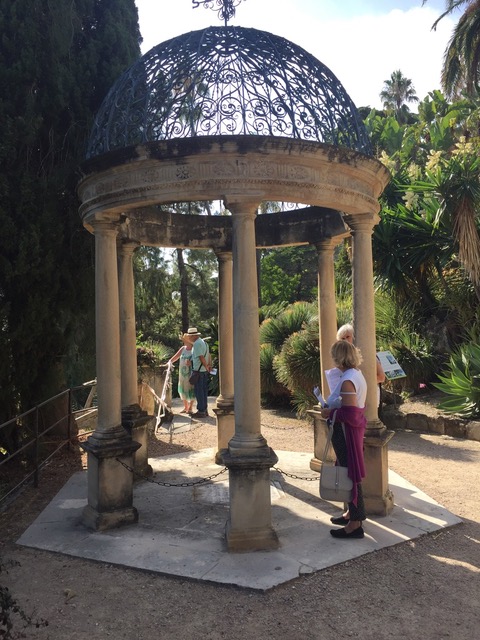
Temple of the 4 Seasons, Dorothy Hanbury is buried beneath it.

Between 1925 and 1939, Sir Thomas's daughter-in-law, Dorothy Hanbury, made many changes to the garden.

The garden suffered in WW2 and was given to the Italian State in 1960, then in 1987 it was entrusted to the University of Genua.

The Hanbury family still owns a property on the site.


No matter what time of the year you visit, it is always impressive.  Most of our group had not been there before and were absolutely amazed at the sizes of some of the Aloes, Agaves, Yuccas, Cacti and Succulents. Although Aloe and Agaves look alike, the difference can be felt in the spines on the leaves, Aloe's leaf margins are softer.

 Agave with small Echinocactus in front

Betty 


 Agave victoriae-reginae

In the front:  Agave attenuata

Dasylirion serratifolium, with razor sharp edges, unlike Agave's the plant does not die after flowering. (Mexico)

Doryanthus palmeri (Australia)

Cyphostemma juttae (south Namibia)

Euphorbia candelabra (from Somalia to South Africa)

After this very hot summer not much was in flower. We came across two orange flowering bulbs, never encountered before.

Haemanthus coccineus

Brunsvigia josephinae

Brunsvigia josephinae in different stages of development

Some shrubs that were interesting:

 Hibiscus rosa sinensis

 Hibiscus moscheutos

 Salvia leucantha

 Leucophyllum frutescens with Solanum rantonetii behind (in our area in a protected spot)

Solanum rantonetii

Ceratostigma plumbaginoides, does very well in our area, originally from W. China

Eriocephalus africanus (South Africa)

In the Japanese Garden there is lovely pond with turtles and goldfish, with a dragon fountain surrounded by foliage, Cyperuspapyrus and Calocasia esculenta leaves:


Cyperus papyrus in between the Calocasia esculenta with above the cave with the statue of the 'Slave'

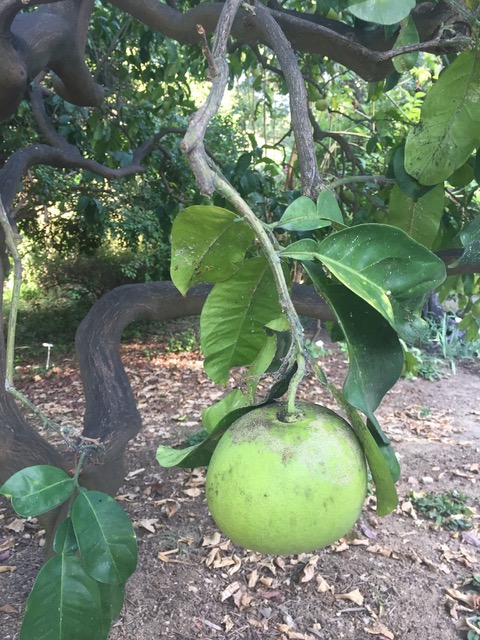
Almost at the bottom of the walk there is a large area of ancient varieties of citrus fruit


Citrus maxima (Pummelo) can weigh up to 1.8 kg


Mermaid Fountain

We were lucky with the weather and although it was a long trip, I think most of us found the day worthwhile.

Our thanks to Marie-France for taking the photos.

15 October 2019

Cosmos


On one of our garden group meetings in spring the members who were present were given a packet of Cosmos seeds in 3 colours, white, light pink and deep pink. The idea was that they would sow the seeds and at the end of the summer we would  compare photos.

With our hot summer, the members who tried to grow the seeds did not have much success apart from Angela Stokes. She planted them quite soon after the meeting, before the hot period started, straight into biodegradable pots. It was a great success, her Cosmos plants flowered all through the summer and are still flowering as you can see:


LinkWithin

Related Posts Plugin for WordPress, Blogger...