19 October 2019

Bordighera and Hanbury Gardens in La Mortolla, 26/9/2019

Wrestling women

11 of us shared transport on our trip to Italy.  It was market day in Bordighera.  A popular small market along the sea front.  I think most of us could not resist buying something.  We had lunch in a restaurant off the main road going through Bordighera.  Not a success, I remember Marie-France ordering 'Pasta a la Vongole' with just 3 clams in her pasta. Despite the very average lunch we had a nice time as a group.

After lunch it was off to the Hanbury Gardens in La Mortola. The property spans the whole of the Mortola Cape, in total 45 acres, the gardens occupy half of it. The rest is left to indigenous vegetation.

Gillian with a view of San Remo in the distance

After earning a fortune in trading in China, Thomas Hanbury purchased the land together with the ruins of a 11th palazzo built by the Lanteri family.

 The Palazzo

The landscaping of the garden was in the main the work of Ludwig Winter recommended to Sir Thomas Hanbury by Charles Huber, a nursery man living in Hyeres.

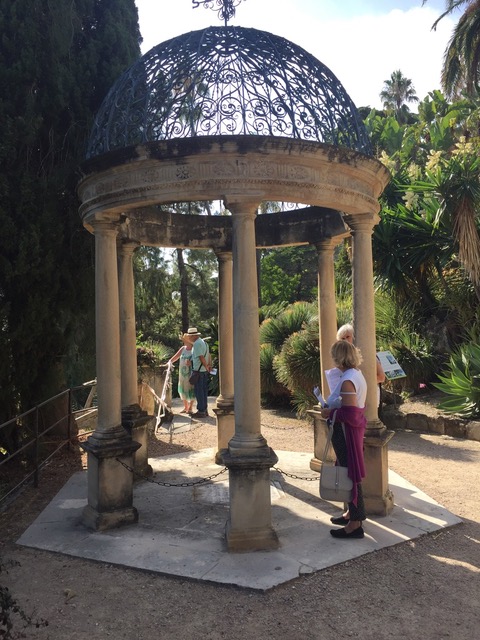
Temple of the 4 Seasons, Dorothy Hanbury is buried beneath it.

Between 1925 and 1939, Sir Thomas's daughter-in-law, Dorothy Hanbury, made many changes to the garden.

The garden suffered in WW2 and was given to the Italian State in 1960, then in 1987 it was entrusted to the University of Genua.

The Hanbury family still owns a property on the site.


No matter what time of the year you visit, it is always impressive.  Most of our group had not been there before and were absolutely amazed at the sizes of some of the Aloes, Agaves, Yuccas, Cacti and Succulents. Although Aloe and Agaves look alike, the difference can be felt in the spines on the leaves, Aloe's leaf margins are softer.

 Agave with small Echinocactus in front

Betty 


 Agave victoriae-reginae

In the front:  Agave attenuata

Dasylirion serratifolium, with razor sharp edges, unlike Agave's the plant does not die after flowering. (Mexico)

Doryanthus palmeri (Australia)

Cyphostemma juttae (south Namibia)

Euphorbia candelabra (from Somalia to South Africa)

After this very hot summer not much was in flower. We came across two orange flowering bulbs, never encountered before.

Haemanthus coccineus

Brunsvigia josephinae

Brunsvigia josephinae in different stages of development

Some shrubs that were interesting:

 Hibiscus rosa sinensis

 Hibiscus moscheutos

 Salvia leucantha

 Leucophyllum frutescens with Solanum rantonetii behind (in our area in a protected spot)

Solanum rantonetii

Ceratostigma plumbaginoides, does very well in our area, originally from W. China

Eriocephalus africanus (South Africa)

In the Japanese Garden there is lovely pond with turtles and goldfish, with a dragon fountain surrounded by foliage, Cyperuspapyrus and Calocasia esculenta leaves:


Cyperus papyrus in between the Calocasia esculenta with above the cave with the statue of the 'Slave'

Almost at the bottom of the walk there is a large area of ancient varieties of citrus fruit


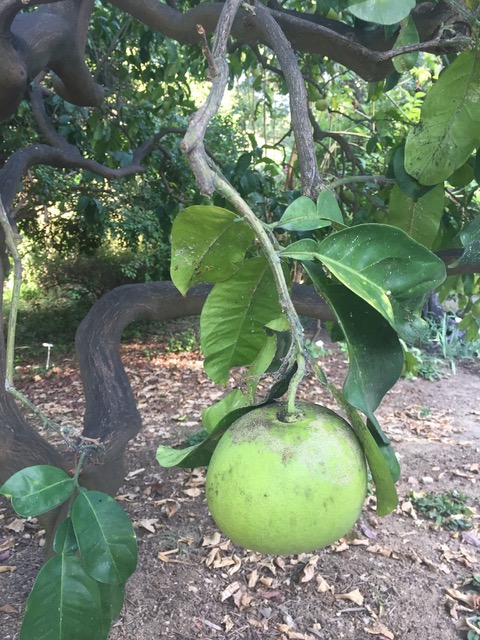
Citrus maxima (Pummelo) can weigh up to 1.8 kg


Mermaid Fountain

We were lucky with the weather and although it was a long trip, I think most of us found the day worthwhile.

Our thanks to Marie-France for taking the photos.

15 October 2019

Cosmos


On one of our garden group meetings in spring the members who were present were given a packet of Cosmos seeds in 3 colours, white, light pink and deep pink. The idea was that they would sow the seeds and at the end of the summer we would  compare photos.

With our hot summer, the members who tried to grow the seeds did not have much success apart from Angela Stokes. She planted them quite soon after the meeting, before the hot period started, straight into biodegradable pots. It was a great success, her Cosmos plants flowered all through the summer and are still flowering as you can see:


05 July 2019

Our visit to Mas de l'Advocat in Eygaliere and Mas de l'ilot just outside Tarascon, 18 June 2019

We were very fortunate to be able to see these two private gardens, thanks to Gillian Duffy who knows the owners.

Mas de l'Avocat

On a lovely, sunny morning 12 of our members met at Mas de l'Avocat owned by Guy and Lydia Bradley. You enter the garden over a narrow bridge spanning a stream, follow a drive way lined with plane trees before you reach the Mas, and what a lovery Mas it is.  It has been built in 3 stages, the oldest part dating back to 1683, the middle part dates back to 1794 and the latest addition to 1830.


The view from the house is impressive, it is a layered view, first you notice the Alpilles, then below the Alpilles your eyes rest on Cypress Trees, below the Cypress Trees, the yellow of a Hay field, below the Hay field, Lavender and finally the lawn stretching to the court yard.


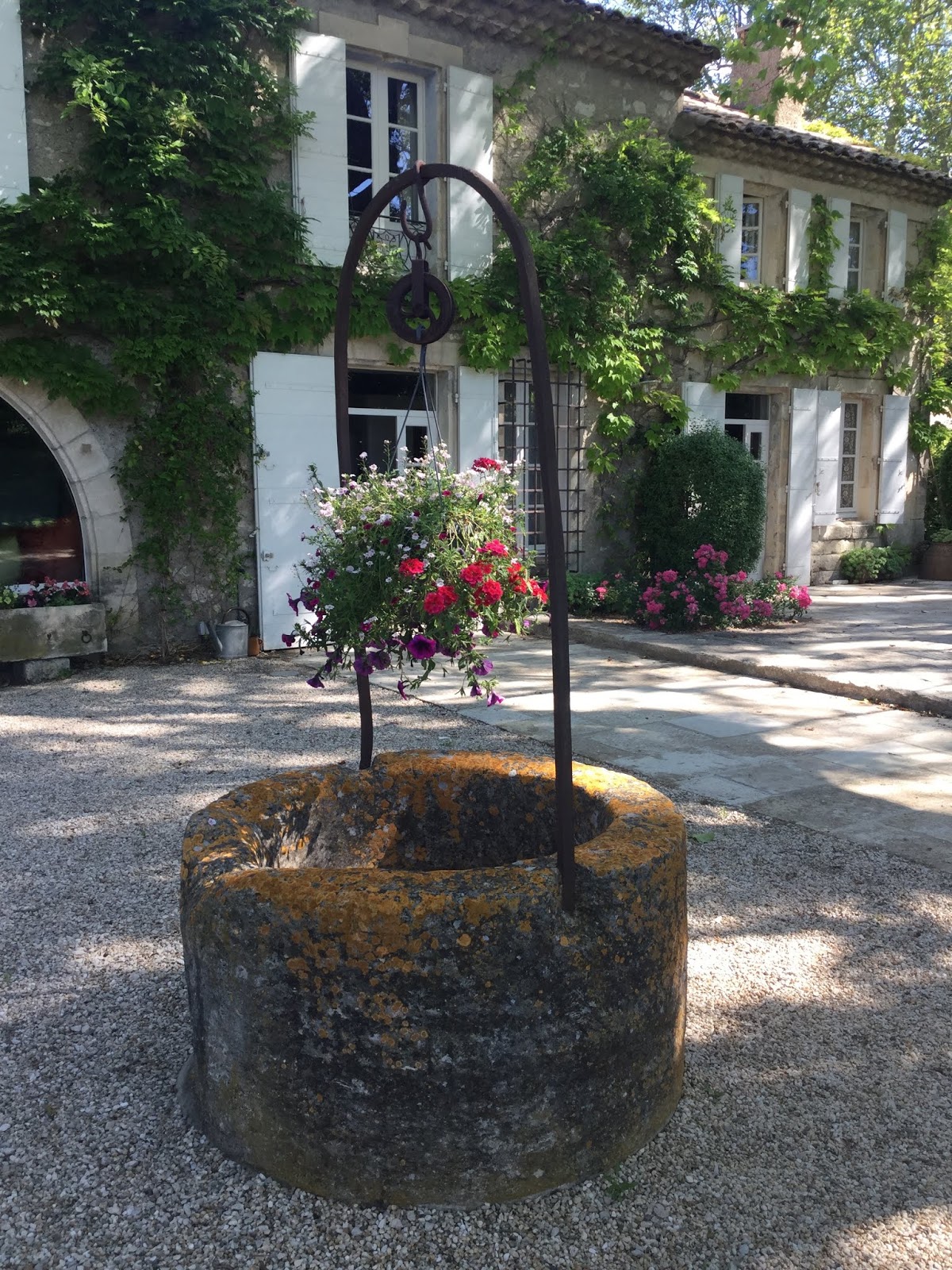
The front of the house is shaded by 2 very mature Plane trees and in the middle a well head made of Eygaliere stone.  Apparently in the area all well heads were made of that particular type of stone.

The garden is large, 8 ha. and divided into different sections, most of them named after a tree or ornament in that particular area. The planting is dominated by trees and shrubs originating from the Far East, mainly Japan and China.

There is no shortage of water in the area, in fact there is sometimes too much water and flooding of the lawn has occurred, hence the border have been built up on a slope so that the plants do not get water logged. It was once swamp land, drained in the Middle Ages.  Under the layer of earth is a solid layer of tuff, a type of rock which is impregnable.

Through a pergola clad with Roses and Wisteria we arrive in the section, called the Monkey Puzzle  Tree (Araucaria araucana) area named after the tree at the far end. Guy's study looks out on this part of the garden. On the left Olive trees, on the right shrubs and trees planted on a slope with a lawn in the middle.


We were wondering why some of the shrubs were covered in green tarpaulin. This is to protect the rhododendrons that are underneath the tarpaulin.  Apparently they can take heat and sun but not both at the same time.


The shrubs and trees are planted into a liner and then covered by cocos matting, which when it wears down a bit, looks very much like soil.  The soil that was used was ordinary garden soil mixed with ochre.

Some of the trees and shrubs planted in the border are:

Toona sinensis (Chinese Mahogany Tree).
Nandina domestica.
Erythrina crista - gali.
Sophora japonica.
At the bottom of the slope near the lawn, Hemerocallis and Gaillardia's.

Just further along we passed the future Jardin d'Ete, or Tea garden.  Sophora japonica is draped over a circular pergola but has not yet covered it.  The area is surrounded by Osmanthus, not in top condition. They've had a problem with the rat taupier, a type of rat that make small hills of earth like a mole and eats the roots of trees and shrubs.


Some of the shrubs and trees encountered:
Hydrangea quercifolia.
Catalpa bignonioides.
Melia azedarach.

Onwards into the rose garden, which is Lydia's, Guy's wife, creation. An impressive framework of wrought iron, a bit like large versions of spokes of a wheel, again on a slope, has specifically been created by the blacksmith for the climbing roses.  Never seen anything like this before, quite ingenuous. Apart from the climbing roses there are quite a few shrub roses.

From there into a circular garden with different varietis of Phormiums, Yuccas and grasses. A central bed is planted with Japanese Imperata' 'Red Baron' Grass, which needs a bit of care.


We make a turn into the next section. As we turn there is a semi circular wall built in a unique way. The stones are set in such a way to form a semi circle.  When you look from a far the wall has a pleated effect.  In front of the wall are several Gunnara's.

Apart from making a framework for the roses and the pergola, the blacksmith made another one for the Cedrus Atlantica 'Glauca' (Weeping Blue Atlas Cedar).  Under the framework are rows of Escallonia.

We now enter the Cedar room with different types of Conifers.  In the centre is a bed of Stipa grass, particularly attractive when the wind is blowing.


From there into a section called 'Espace Matisse', 5 red Acer japonicum represent the dancers in Matisse's painting 'Dance'.


Another unusual tree encountered is Chitalpa tashkentensis a pink flowering tree with flowers similar to Catalpa flowers but with very different leaves.


Forward into the Theater area.  No performances have been given to date, but it could possibly seat 50-80 people.

A wole area of Bamboos have been planted with metal borders 70 cm deep.


There is even a fruit orchard with peaches, nectarines, pears, figs sour cherries and medlars.

Some trees along the way:

Rhus typhina
Metasequoia, a deciduous conifer.

Along a path on one side pillar with in between Taxus baccata. Once the Taxus becomes mature it will be clipped to the same size as the pillars.  On the other side a variegated bamboo, not sure of the name but it could be Shinochima bamboo. 70 cm deep metal strips surround the bamboo are to prevent the roots from spreading.


Then into the Japanese garden.  Based on Japanese principles like running water in form of a small waterfall, a pond with waterlilies and Iris ensata, a Japanese water iris quite striking as the 3 petals are horizontal.  In the middle of the pond is an island with a small tree in the centre.  From the pond runs a pebble stream bed.  


All  along on one side of the pond are Japanese Acers of various colours.  Rather striking.

The last part we saw was the swimming pool area and from there back to the car.  Although the garden is only 5 years old some of the trees are quite mature and the planting being mostly acid loving plants in a calcaire are
a must be challenging. I guess anything is possible with a lot of care and energy.

=================

After a lunch Chez Paulette in Eygaliere we went on to the second garden of the day, Mas de l'ilot with its formal garden just outside Tarascon.

==================

Mas de l'ilot

Simon and Andrea Farley bought the property in 2007.  The garden is made up of box parterres, perfect to the eye, but apparently not 100% aligned.


The drive up the the house is through a path of pink Oleanders up to the parking area.


From the parking to the front of the house you pass a whole area of shade loving plants.  Hydrangea arborescent 'Annabelle', as well as Hydrangea paniculata and Hydrangea quercifolia, with its oak-like leaves. We were there just at the right time as they were in full bloom.

Hydrangea quercifolia


Hydrangea arborescens 'Annabelle'


A path to the left and right of the house takes you all around the garden with access to the central part here and there.

The path to the right of the house was lined with Campsis cut into tree form, never seen that before and underplanted with white Irises, now finished flowering, white lilies and Lavandin 'Grosso', the largest and most flower producing Lavandin and Taxus bachata


The central part has box parterres with circular pruned olive trees.  A whole is left in the middle for light.


All around the garden are statues bought mostly in the U.K. As the soil contains lots of iron most of the statues have a rust coloured tint to them. Stone toad stools (staddle stones) are scattered around the parterres.  In the olden days they were used as supporting bases for graneries and hayricks.


At the bottom of the garden we take the path to the left of the house leading us back to the parking area.  The beds on either side of the path are covered in Agapanthus in bud.  How lovely that must be when they are all in flower.


Just at the end there are rose beds filled with red and white roses.


Photos:  Jacqueline Hodkinson & Angela Stokes


16 May 2019

Visit to a woodland remarquable in Gassin on 14th May 2019


Ten members of the garden group visited the jardin remarquable of Mme. L’Hardy-Denonain in the tiny village of Gassin behind St. Tropez and Cogolin in the Var, France.   The advance guard of three set off at 8.30am for St. Tropez market but their early start received a set-back when it was discovered that the car’s protective undercarriage was held in place by just two bolts and a piece of wire and the front piece was touching the ground (kind husband volunteered to attend during the day with more wire) and we set off in another car.

A word of warning for those who are not familiar with the road from Le Cannet-des-Maure to St. Tropez – it is not for the nervous driver, there are apparently 75 bends (the section from La Garde Freinet to the coast is wider and the bends more stretched out than the first section).   But beware the large lorries on their headlong dash to the A8 motorway, we met five in close succession!

The second hiccup was that, surprisingly for mid-May, the port car park was listed as FULL and the reason became clear when we discovered a large fairground had been set up in the Place des Lices and no sign of a market.   This prompted an immediate visit to the cake shop for consolation but luckily a call from the car repair husband miraculously prompted a passerby to explain that the market had been set up in the port car park.

Mme. L'Hardy-Denonain's garden received its jardin remarquable status in 2009 (renewed in 2016) because of its collection of botanic collection of plants - of which there will be no mention here because both our plant experts were absent!  

The garden is about 2,800 sq.m.
was bought by Mme. L’H-D’s mother-in-law in 1973 in an abandoned state and comprises four narrow steep restanques.   Unusually, the garden is not attached to a house but is close to the family village house which, if I understood correctly, Mme L’H-D’s mother-in-law renovated (she was anarchitect), removing the internal stairs and building a tower on the side of the building containing the stairs - giving access to each floor to increase the size of the small rooms.

The garden is accessed through the outside terrace of a restaurant and down steps to the cabanon built against the road’s retaining wall.   The visit began with Mme. L’H-D sitting in the doorway to the cabanon with her visitors perched on stools to listen to the story of the garden.   When the land was bought, the cabanon housed the chickens with the pigs in the side annexe; and the horse stabled under a village house opposite grazed the restanques in between the vegetable plots (allotments?) maintained by the villagers.  

On the two lower levels there are small patches of gardens bearing the name of a village child - “Jonathan’s garden”, “Mathilde’s garden” (the latter child is now 16 years old and still visits her garden and took Jonathan to task for the abandoned state of his garden, suggesting that he pass it to another child).   “Certainly not” was the reply !  - which illustrates the sentimentality and love of gardening that Mme. L'H-D has created in the generations of Gassin children.   I wonder if they will continue to be as passionate about gardening when they too reach the venerable age of 94?

Many plants were more leggy than usual because the whole garden was shaded by mature trees.   Mme. L’H-D does not feed any of the plants, watering is limited to new planting (there is a stand-pipe for water on each level) and mulching is done by Mother Nature's annual fall of autumn leaves.    Most plants are labelled but you will not find modern, type-written or bar-coded labels here, everything is handwritten.   T
his is not an immaculate garden but the passion for plants is there and it was good to hear that, although she does not have a gardener, Mme. L’H-D does have volunteers to help her.  

The plant I will now buy for my really shady area will be the Raphiolepsis indica (Indian hawthorn) just full of pink flowers and dark green leaves – considerably taller than the plant description, presumably aiming for the light.   And perhaps I ought to buy some of the tiny fish that eat mosquitos to put in my rainwater cuves which were the practical Piscean inhabitants of the small basin in company with acquatic plants.

Despite her 94 years, Mme. L’H-D continues her routine of summers spent in Gassin and winters divided between Brittany and Sark, and summers spent walking up and down the restanques with her visitors obviously keeps her fit !

We finally emerged into the sunlight and stopped off at the tiny ice cream shop for a reviving shot of sugar.

WHERE TO BUY  Raphiolepsis indica delcourii
(different varieties:  Springtime, Pink Cloud, Kerdalo, Coates Crimson)
Pot sizes vary, 3-litre up to 8-litre, Jardiland (Frejus and La Garde) will not deliver.
None of these websites have any stock except for Promesse des Fleurs (inspiring small brochure)

https://www.truffaut.com/produit/raphiolepis-x-delacourii-springtime-conteneur-7-5-litres/178836/25223
https://www.jardiland.com/raphiolepide-de-l-inde-springtime-9004274.html    8 litre pot or €11.43 / 3 litre pot
https://www.jardiland.com/raphiolepide-de-l-inde-pink-cloud-9030379.html
https://www.promessedefleurs.com/arbustes/arbustes-de-a-a-z/rhaphiolepis-spring-time-raphiolepis-delacour.html   3 litre pot  IN STOCK
http://www.pepiniere-bretagne.fr/detail-article.php?ID_ARTICLE=9187    R. x delacourii). pot size unknown, no price, out of stock

Good websites for info (and for all plant info too): 
https://jardinage.lemonde.fr/dossier-2022-rhaphiolepide.html
https://www.rhs.org.uk/Plants/62762/Rhaphiolepis-x-delacourii-Coates-Crimson/Details?returnurl=%2Fplants%2Fsearch-results%3Fcontext%3Db%25253D253460%252526hf%25253D10%252526l%25253Den%252526s%25253Ddesc%25252528plant_merged%25252529%252526sl%25253Dplants%26s%3Ddesc(plant_merged)%26form-mode%3Dtrue%26page%3D25350%26aliaspath%3D%252fplants%252fsearch-results


PHOTOS:


Written by Sue Spence, photos by Francoise Geeraert
 

LinkWithin

Related Posts Plugin for WordPress, Blogger...