05 May 2015

Val Rahmeh - 29 April 2015

Our long distance garden visit this year was to Menton to visit Val Rahmeh in the morning and Clos du Peyronnet in the afternoon.  We were lucky with the weather, especially in the morning.

Justicia brandegeeana (Shrimp plant)


Strelitzia reginae (Bird of Paradise) with its striking orange flowers with on the far left the elegant palm fronds of Syagrus romanzoffiana (Queen Palm)

Clivia miniata

In the late 19th, early 20th century there was an enormous interest, in particular among wealthy British people, to establish gardens along the Mediterranean coast from Genoa to Toulon.

Phoenix canariensis

Upon retirement in 1905, Sir Percy Radcliffe, a general in the British Army, and his wife Rahmeh Theodora Swinbourne bought a parcel of land in Menton. His wife died in 1924. He remarried and it was his second wife who named the garden 'Val Rahmeh'.  The name 'Rahmeh' means tranquility. Sir Percy Radcliffe died in 1934. After his death the garden had several owners till in 1957 May Campbell bought the property and named it 'Casa Rosa'.  In 1966 she sold the garden to the French State who renamed the garden as it was originally called 'Val Rahmeh'.


It is a botanical garden with more than 1700 species from all over the world. The micro-climate of Menton is ideally suited to sub-tropical and some tropical plants. The dense vegetation, the colourful plants and the species from all over the world makes you feel you are in the tropics.


The terrace in front of the house with Cordyline australis (looks like a palm but is not) in the foreground, several palms and various other plants

Sabal palmetto (Cabbage Palm) with blue/black seeds:


Livistona chinensis (Chinese Fan Palm):

Livistona chinensis (Chinese Fan Palm) on the far right

Dicksonia (Tree Fern):


together with shrubs like:

Brugmansia spp. - Brugmansias differs from Datura by being a shrub, up to 11 m, with pendant flowers:


Papaya carica - normally a tropical fruit:


and climbing along the walls Beaumontia grandiflora:


close up of a Beaumontia flower

and a wonderful fragrant rose, native to Southern China and Taiwan - Rosa laevigata:


There were a few ground covering plants: Liriope muscari, it was in leaf when we saw it:


Tradescantia sillamontana - a green variety of 'Wandering Jew':


between the flag stones Anigozanthos flavidus (Red Kangaroo paw):


The strangest plant in this section of the garden was Chorizia speciosa - Silk Floss Tree.  The first thing you notice is the bark of the tree, covered with sharp spines. When we looked at the canopy,  green fruits, the size of avocado's were hanging from the tree.  Although they look like avocado's, they are in fact filled with a fluffy matter which resembles kapok. When in flower, the flowers are pink or white.


Continuing our guided walk we passed very mature citrus trees. As citrus trees have been cultivated from 1000 BC, it is hard to be exact about their origins. It is thought to be between the south-east edge of the Himalayas, Assam  and the north of Burma.  From there the trees have spread to India, China (Yunnan), Japan and the Malaysian archipelago, then to the rest of the world. The first citrus fruit that came to Mediterranean region was the Citrus medica (Cedratier), the fruit looks very much like a nobbly, large lemon:


 There are many varieties of Citrus medica, Buddha's hand is one of them:

Citrus medica var. sarcodactylis

The second name 'medica' suggest it must have come from Medea to our region.  Medea was a large country which spanned part of Turkey and Iran.

A very large Fortunella (Kumquat) tree:


Another Chorizia in the garden is Chorizia insignia - similar to C. speciosa except that with age the trunk becomes bottle-shaped:


The well-known houseplant Monstera deliciosa is a climber. Also know as the Fruit Salad Plant, the ripe fruit tastes like a combination of banana, pineapple and mango. It takes more than a year to ripen:


Tillandsia of many varieties, aerial roots provides all their needs:


Tillandsia usneoides to the left, Tillandsia fasciculata to the right

Several magnificent Echiums are scattered around the garden. When you look carefully at the individual flower, you can see the similarities with the Echium vulgare which flowers in our area in the wild:

Echium canariensis

Echium nervosum


Salvia canariensis

Tropaeolum pentaphyllum from South America a true rambler, it winds itself through large area of plants:


Lantana montevidensis (or L. sellowiana) - weeping Lantana:


a close-up

An undulating hedge has been sculpted from Cupressus sempervirens:


The orange succulent on the right is Bulbine frutescens
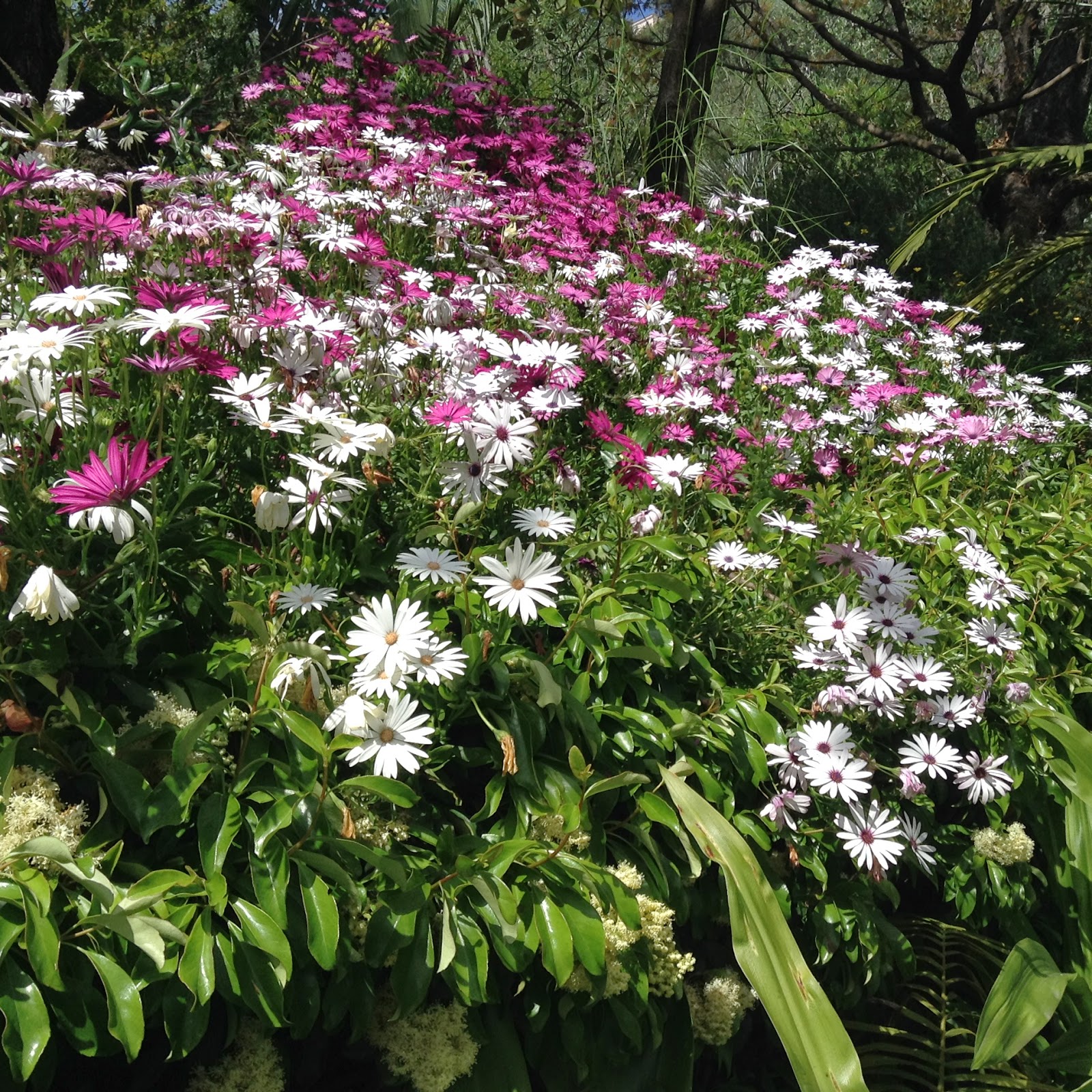
Osteospermum jucundum

Our guide standing in the medicinal plant section, the orange flower next to him is Leonotis leonurus

Some interesting medicinal plants growing in the garden from all over the world:

Erythroxylum coca a bush between 2-3 m, from the Amazonian region from which cocaine is processed:


Catha edulis (Khat) - a plant that is chewed a lot in the Horn of Africa and the Arabian peninsula, it causes excitement, loss of appetite and euphoria:


Ricinus communis (Caster Oil Plant) - the seeds produce castor oil. Caster oil was widely used as motor oil, now mostly replaced by synthetic oils. The plant is considered to be one of the most poisonous plants in the world, 4-8 seeds is enough to kill an adult with painful and unpleasant symptoms:


Ruta graveolens, once used to cause abortion:


Elettaria cardamomum - Cardamon - ginger like in appearance. The guide gave us a leaf to smell, not quite like the seed but very aromatic:


Sophora toromiro or for short Toromiro is a plant that originally grew on Easter Island. Easter Island was discovered in 1722 by the Dutch navigator 'Roggeveen'. The discovery was made on Easter Sunday, hence he named the island 'Easter Island'. The island was covered in a sort of shrubland, the Toromiro was one of shrubs with a height of around 2 m, with a twisted trunk the width of a man's arm. The Polynesian settlers sculpted all their famous red wood statues from Toromiro wood. Through overgrazing this shrub has disappeared from the island. In 1956 Thor Heyerdahl's team took a branch with seed pods to the Botanic Garden in Gothenburg. When he returned to the island in 1962 there were no more Toromiro's. The plant was reproduced from seeds and 'in vitro' culture. A specimen from Gothenburg was planted in Val Rahmeh at Easter 1993. It is the only Toromiro growing in the open air in Europe:


Toromiro flower

A tree that was noticeable in many parts of the garden was the Erythrina caffra - African Coral Tree with bright orange flowers. The seeds are orange-red, in Africa they are used to make jewellery:


African Coral Tree Flower


Carla and Herta

A climbing hydrangea with a powerful smell:

Decumaria


A most unusual climber:

Mucuna atropurpurea

We were told by the guide that the tallest bamboo in the world, Dendrocalamus giganteus, grows 1 m per day for 32 days. The story goes that when one of these bamboos flowers, all the other Dendrocalamus giganteus bamboos that exist in the world, flower at the same time. True or Untrue?

Dendrocalamus giganteus

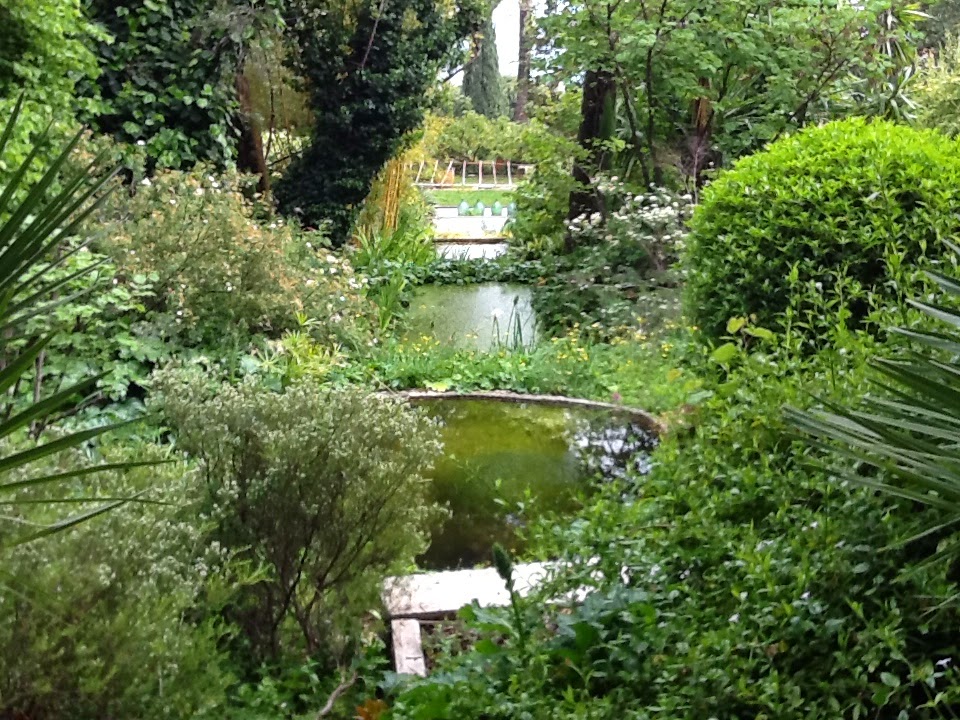
The last part of the garden we visited was the waterlily pond:

on the far side is the Mexican Weeping Bamboo - Otatea acuminata


Papyrus growing at the water's edge


Clarisse and June having a bit of a rest


Jasminum officinalis


Photos:  Lilianne Feldman, Jacqueline Hodkinson, Tineke Stoffels and Gabrielle Wellesley

Clos du Peyronnet - Garden Group Visit - 29 April 2015


This is our second visit to Clos du Peyronnet.  The last time was on 12 June 2012 - 3 years ago.  Different plants were in flower. William Waterfield showed us around as before. Not often do you find a house that has been owned by the same family for over 100 years. William Waterfield's grandparents bought the house in 1912 from a Mrs. Troubridge.  After the death of his parents during the Second World War, their son Humphrey, William's uncle remodelled and replanted the garden. When Humphrey died in 1971, the house passed on to his brother Anthony Waterfield, William Waterfield's father and then to William himself.  William has lived in the house since 1976.  The house is now divided up in apartments.


The front of the house is covered in a beautiful Wisteria, with double flowers, Wisteria sinensis:


In front of the house is a lawn with several varieties of Mimosa and Salvias. There were two Salvia's in flower:
Salvia discolor with very sticky leaves, with almost black flowers

and

Salvia guaranitica


Paeonia 

From the front garden you could see a Fremontodendron californicum in flower:


close up of the flower

and on the opposite side a Dombeya burgessiae with its spherical pendant flowers:


There are many lovely pots all around the garden.  Some, like this Anduze pot were specially made for Laurence Johnston of Serre de la Madonne by the Anduze pottery Boisset:


Corinthe major given to William by Joanna Millar of Domaine du Prieure in Tourrettes-sur-Loup. We visited her garden in May 2013.

Geranium maderense


A very good rose according to W. Waterfield - Rosa cooperi


Aeonium arboreum, several of us were given a cutting.  On our morning visit to Val Rahmeh, there was another Aeonium arboreum with deep purple leaves and a green heart, Aeonium  atropurpureum


Caesalpinia gilliesii, according to W. Waterfield, it should do fine in our area


Rosa banksiae in full bloom with the sea in the background


The water staircase with 5 pools cascading down the hill made by William's uncle Humphrey


Bletilla striata


Sue together with William Waterfield


Photos:  Lilianne Feldman, Jacqueline Hodkinson, Tineke Stoffels, Gabriella Wellesley

11 April 2015

Xylella fastidiosa - Additional info on this damaging new bacterium


Hilary Smith received more info on the Xylella fastidiosa bacterium and has again kindly translated the article for us. As many of our members have olive trees, the more we know, the more we can be aware of this peril.

Dans le sud de l'Italie une bactérie décime les oliviers. L'Hexagone a ainsi décidé d'interdire, dès ce dimanche, l'introduction de végétaux en provenance du sud de l'Italie.

In the south of Italy there is a bacterium which is decimating the olive trees.  Therefore the “Hexagon” has decided that from this Sunday it will prohibit the import of vegetable matter coming from the South of Italy.

Le gouvernement ne veut lui laisser aucune chance de franchir les frontières de la France.

The Government doesn’t want there to be any chance of it crossing the French Frontier.

Pour lutter contre la bactérie Xylella fastidiosa, qui fait actuellement des ravages dans les oliviers de la région des Pouilles en Italie, le ministère de l'Agriculture interdit dès ce dimanche les importations de tous les plants susceptibles d'être porteurs de la maladie, originaires des Pouilles et «des zones infectées des pays tiers concernés».

In order to combat the bacterium Xylella Fastidiosa, which is currently ravaging the olive trees of Puglia in Italy, the Minsiter of Agriculture  has forbidden, since Sunday, the importation of any plants which might possibly be carriers of the disease originating in Puglia and « infected zones of other lands which are affected.” 

Cette mesure sera assortie du renforcement du plan de contrôle et de surveillance sur l'ensemble du territoire national. «La menace est réelle pour la Corse et l'ensemble du pourtour méditerranéen.
This measure will be matched by the reinforcement of a plan of control and surveillance across the whole of the country.  “The menace is real for Corsica and the whole of the Mediterranean area. 
En plus des oliviers, cette bactérie peut toucher les chênes, les amandiers, les vignes. Elle peut infecter jusqu'à 200 espèces! Si elle pénétrait dans la région, elle pourrait décimer des forêts entières. La situation deviendrait incontrôlable, comme c'est le cas en Italie», prévient Fabienne Maestracci, oléicultrice en Corse et membre du syndicat Oliu di corsica.

In addition to olive trees, this bacterium can affect oaks, almonds, and vines.  It could infect up to 200 species.  If it penetrates the region it could decimate entire forests.  The situation would become uncontrollable, as is the case in Italy, forecasts Fabienne Maestracci, a Corsican olive producer and member of the Oliu di Corsica.

Dans les Pouilles, où Xylella fastidiosa est apparue pour la première fois en 2013, la situation est catastrophique. Selon le commissaire européen à la Santé, Vytenis Andriukaitis, 10% des 11 millions d'oliviers de la province de Lecce sont touchés par cette bactérie. A terme, ce sont tous les 60 millions d'arbres des Pouilles qui sont menacés.

In Puglia, where Xylella Fastidiosa appeared for the first time in 2013 the situation is catastrophic.  According to the European commissioner of Health, Vytenis Andriukaitis, 10 % of the 11 million olive trees in the Province of Lecce are affected by this bacterium.   In a word, all 60 million trees in Puglia are being threatened.  

La maladie, qui se caractérise par un dessèchement des feuilles et la mort de l'arbre dans les cas les plus graves, ne dispose d'aucun remède. La seule solution est l'arrachage et la destruction des arbres malades.

The disease which is characterised by dried leaves and the death of the tree in the worst cases, has no remedy. The only solution is to uproot and destroy the diseased trees.  

Faute de remède, l'Italie a mis en place une zone de confinement de 241.000 hectares dans les Pouilles. Mais la bactérie se propage à grande vitesse, transportée par des insectes (cicadelles et cercopes). Vytenis Andriukaitis a demandé au gouvernement italien de renforcer la taille de cette zone de confinement et de créer une zone tampon autour des foyers signalés.

With no remedy Italy has established a containment zone of 241,000 hectares in Puglia.  But the bacterium propagates itself very quickly, carried by insects (cicadelles and spittlebugs).  Vytenis Andriukaitis has demanded that the Italian Government intensify the pruning in this containment area and to create a buffer zone around designated homes.

Le commissaire a appelé les pays voisin à la «vigilance absolue». En France, la Direction générale de l'alimentation (DGAL) et l'Agence nationale de sécurité sanitaire de l'alimentation, de l'environnement et du travail (Anses) ont relayé cet appel. En Corse, la préfecture a même mis en place un numéro vert pour permettre aux habitants de signaler tout symptôme suspect dans la végétation.

The Commissioner has called on neighbouring countries for « utmost vigilance”  In France, the DAL and the National Food Health Environment and Work Security Agency (ANSES), have reiterated this appeal. In Corsica, the Prefecture has even put in place an emergency number in order to allow residents to report all suspicious symptoms in vegetation.

«Les touristes ne viendront plus en Corse s'il n'y a qu'un paysage désertique»

Tourists will not visit Corsica if the countryside resembles a desert.
Fabienne Maestracci, oléicultrice en Corse et membre du syndicat Oliu di corsica
L'interdiction d'importer des plants est pour les producteurs du pourtour méditerranéen un premier pas dans la bonne direction, en attendant la mise en place d'un dispositif européen, actuellement en cours de construction. Ces derniers saluent son extension à l'ensemble des pays potentiellement infectés et pas seulement à l'Italie. «Il faut savoir que Xylella fastidiosa n'est pas origniaire d'Italie. On la retrouve ailleurs, en Amérique Latine, notamment au Costa Rica et au Brésil où elle fait des ravages dans les caféiers et les agrumes. Elle serait d'ailleurs rentré en Italie via un plant malade originaire de Costa Rica qui aurait transité par Rotterdam», explique Fabienne Maestracci.

The prohibition of the importation of plants is the first step in the right direction for the producers of the Mediteranean region, while waiting for the setting up of European plans which are currently being put together. These latter commend its extension to countries potentially infected and not only Italy.  You must know that Xylella Fastidiosa did not originate in Italy.  It has been found elsewhere, Latin America, notably Costa Rica, and Brazil where it ravaged coffee trees and citrus trees.  It would anyway have entered Italy via a diseased plant originating from Costa Rica, which would have come through Rotterdam” Fabienne Maestracci explained.


Son syndicat, qui représente 188 producteurs d'huile d'olive en Corse, demande à ce que cette interdiction s'accompagne d'un soutien aux pépiniéristes français. «Pour limiter les risques, il faudrait que les producteurs puissent utiliser des plants fabriqués en France. Mais pour cela, les pépiniéristes ont besoin d'aide, d'autant plus que leur filière souffre de coûts de production plus élevés qu'à l'étranger. Mais il y a du potentiel, notamment avec les jeunes des lycées agricoles. Cela prendra peut-être plusieurs années mais c'est la voie à suivre», assure Fabienne Maestracci. «Autrement, nous prenons le risque de tuer notre patrimoine naturel et culturel. L'impact économique sera aussi important. Les touristes ne viendront plus en Corse s'il n'y a qu'un paysage désertique». 

Her syndicate, which represents 188 olive oil producers in Corsica, demands that this prohibition be accompanied by support from French nurseries “to limit the risks the producers must be able to use plants grown in France. But to do this the French nurseries need help, even more so as their network suffers from higher cuts in production that in other countries.  But there is potential, particularly with the young in agricultural colleges.  It will take several years but it is the path we must follow, assures Fabienne Maestraccii.  Otherwise we risk killing our natural and cultural inheritance. The economic impact will also be important.  Tourists are not going to come to visit Corsica if there is only a deserted countryside to be seen.

LinkWithin

Related Posts Plugin for WordPress, Blogger...