06 July 2014

Le Château de Lourmarin - Château Val Joanis

16 of us made our way to Lourmarin in the Vaucluse to visit in the morning Château de Lourmarin, with lunch in Lourmarin and in the afternoon a re-visit, last visit was in June 2011, to the potager and garden in Château Val Joanis.

The Château of Lourmarin is only a short distance away from the village of Lourmarin.
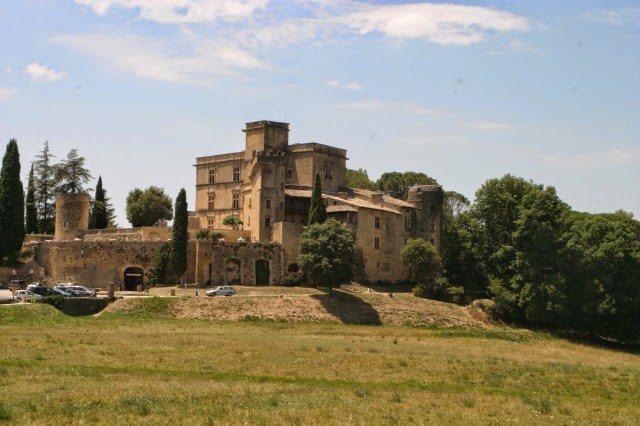

Originally built in the 12th century as a fortress, it was transformed in the 15th century by the chamberlain of King René I of Anjou.  By adding an annex in 1526, the new owners made it the first Renaissance building in the Provence.  After the French Revolution the Château descended into ruins till 1921 when it was bought by Robert Laurent Vibert, a producer of cosmetics.  With the help of Henri Pacon, an architect, he restored the castle.  Unfortunately he died in a car accident in 1925.  He left the Château to the Académie of Sciences, Agriculture, Arts and Belles Lettres in Aix en Provence with the proviso that it would be transformed into a trust to support young artists.


The Foundation developed the library, it now holds 28.000 books and documents.  During the year concerts and conferences are organised and each summer it welcomes young artists (painters, sculptors, musicians, authors and researchers.  They stay at the Château and receive a grant to be able to concentrate on their work.


As you enter the Château a colourful display of roses around a bassin with waterlillies and a sculpture (Reflexsun) by Christophe Bricard attracts your attention.


Lovely views from the courtyard:


Several Anduze pots filled with Geraniums are dotted along the court yard.


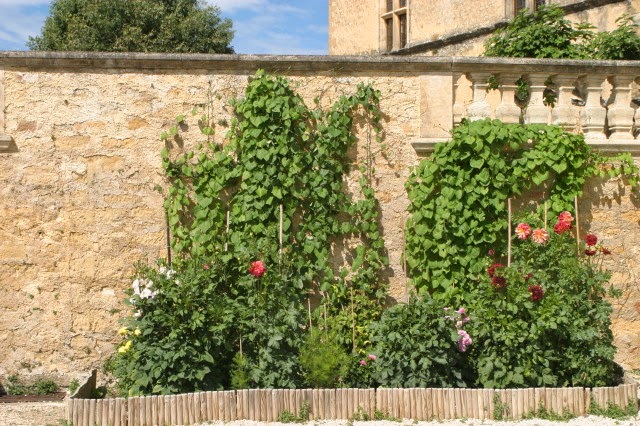
On our way to the entrance to the tower, we passed a bed of magnificent Dahlias.  Behind the Dahlias, Ipomoea indica (blue flowering Morning Glory).

The first room to visit is the Dining Room with 3 original beams near the old fireplace.


All along the walls are engravings of Rome by Giovanni Battista Piranese (1770-1778).  Goethe, having seen the engravings by Piranese, was disappointed when he visited Rome, it was nothing like the engravings.  An Aubusson tapestry (only 2 vegetable dyes were used, blue-green and brown) adorns the walls.  A showcase with Murano glassware and a large Delft Blue vase.

The kitchen with furniture of N.E. France.  Gleaming copper ware, an old Biot olive oil jar in the corner of the fireplace.


An incredible spiral staircase leads to the floors above, next the Ladies Bedroom


Further up the staircase we pass another bedroom similar in style to the ladies bedroom, and right on top is the music room with several pianos, harpsichord, drums and oriental instruments hanging on the walls.


After our visit we had some time to visit Lourmarin.  Lots of tempting shops.  Most of us had lunch at Restaurant 'La Recreation', before setting off to Val Joanis.


After lunch we made our way to Château Val Joanis, 1.5 km outside Pertuis.  It is a 400 ha. estate of which 100 ha is planted with vines.  It was once owned by Jean de Joanis, secretary to King Louis III of Naples.


After being neglected for many years Val Joanis was bought in 1977 by the Chancel family.  Cécile Chancel with the help of architect, Tobbie Loup de Viane, decided in 1978 to create a potager that resembled château potagers of the 18th century.  Ornamental but at the same time producing all the family's vegetables, fruits and flowers.


They started the project in 1980, it was finished in 1990.  In 2005 the potager received the honour of being chosen as a 'Jardin Remarquable' and in 2008 it became 'Jardin de l'année 2008. In 2011 the château was sold to a German/Dutch couple, the family Rosen.

The garden is divided up into 3 terraces:
The potager.
Roses and other trained fruit.
Ornamental trees and shrubs.


Punica granatum 'Flore Pleno' a flowering pomegranate

As you enter the potager area, on the left hand side, a metal frame work with horizontal and vertical struts is hiding an unsightly wall.  Pyracantha is trained along the struts.  Rather a good idea.

The potager is divided into beds, between the beds are paths.  The soil in the potager is covered with ground cocoa shells.  The advantages are:

  1. It suppresses weeds and retains moisture.  Once it has been watered or rained upon, it forms a crust binding the cocoa shells.
  2. The rich colour contrasts well with the green foliage of the plants.
  3. It repels slugs and snails.

Every bed in the potager is surrounded by either a small hedge or panels of iron rods (3m long x 30 cm high ) on poles stuck into the ground.


They used quite a variety of plants as hedges, all clipped to the desired height:
Buxes sempervirens (Common Box).
Buxes sempervirens 'Elegantissima' (with a narrow white margin).
Elaeagnus x ebbingei.
Phillyrea angustifolia.
Pistachia lentiscus.
Quercus ilex (our common evergreen oak).

To give form to the potager tall clipped trees were used:
Corylus maxima 'purpurea' (purple leaved hazel).
Laurus nobilis (Bay-leaf) in the shape of obelisks.
Taxus baccata (Yew) idem dito.
Ostrya carpinifolia (Hop hornbeam) clipped into tall panels.
Parrotia persica (normally it grows up to 8 m, with a spread of 10 m).
Cupressus sempervirens 'Stricta', Italian cypres tree.
Espalier apple and pear trees at various heights.

Some grasses:
Miscanthus sinensis.
Imperata cylindrica 'Rubra'.

For decorative purposes and special colourful effects, they planted long rows of:
Bupleurum fruticosum
Caryopteris (green and silver leaved varieties)
Cornus alba 'Elegantissima'


Gaura lindheimeri (white variety)
Indigofera
Inula magnifica


Lagerstroemia
Lavandula  angustifolia and intermedia (Lavander and Lavandin)
Perovskia 'Blue Spire'
Rudbeckia 'Herbstsonne'
Vernonia crinita

Vitex agnus-castus

In amongst the clipped hedges, central partitions, shrubs and perennials; herbs, vegetables and small fruit bushes (red currants, black currants etc.) were grown.

Most of the roses lining the rose tunnel are spring flowering varieties, now finished flowering.

At the moment the most striking colourful feature are the lavenders in bloom.


Photographs: Kelvin Crawford


12 June 2014

Visit 4 June 2014, morning; garden in Cotignac; pot luck lunch: at Rosaline & Bonno; afternoon; a guided tour of Cotignac

Just outside Cotignac on the way to Entrecasteaux on a hillside with beautiful views towards the Maures, lies the garden we visited today, owned by a Dutch family. The property is just under 2 ha. mostly vineyards and olive groves.  They produce their own white and red wine.  They bought the property in 2004, an old Mas which they extended, now 10 years later after renovation and planting it is a very mature site.


The parterre, one of the first things you come across, is not made of box but a dwarf form of myrtle (Myrtis communis).  The parterre is filled with herbaceous plants (agapanthes, foxgloves, peonies, roses and others.  One particular plant,


everyone was wondering about - for sale last year in Cotignac market (Tuesday) in early summer, is Dicliptera suberecta (also known as Jacobinia or Justicia).  Dicliptera is its new name according to the RHS. The leaves are whitish-grey, which you can see if you look carefully, not those other green leaves, they belong to a different plant.


From the front of the house the view is of an undulating lawn, with in the foreground, clipped evergreens. To break up the formality, some low shrubs and roses (Iceberg).  The evergreens they used are all well suited to the climate:
Eleagnus x ebbengui; Lavandula; Phillyrea angustifolia; Photinia x fraseri 'Red Robin'; Pittosporum tobira; Santolina chamaecyparissus (grey-leaved variety); Santolina rosmarinifolia (green-leaved variety); Viburnum tinus.
They've been kept low not to interfere with the distant view of the Maures.


All around the house there are interesting corners with curiosa, chairs and tables.


Walking on,


you come to the pool area, with another seating arrangement.


All very tastefully done.
At the entrance to the pool are two pots with Solanum crispum 'Glasnevin'.


At the end of the visit our hostess served us a fruit cocktail (made up with frozen packet of fruits of the forest; white wine; sparkling water and grenadine), rather fresh and delicious and in addition some cakes.


On we went to Rosaline and Bonno's house, a lovely old mas


with a bassin, on the plain just above the rock face of Cotignac for our picnic lunch.  We were with 30 having lunch, everybody brought a dish, all very delicious.


We were very lucky with the weather, a few drops of rain, but nothing to speak off.  The setting was lovely, the sound of the waterfall, which runs just at the end of the garden, accompanied us all during lunch.


There was enough time to walk around the garden and as usual have a good chat, it is amazing how time flies.

We were 20 for the afternoon visit of Cotignac.


Met at the Tourist Office by the tourist guide we made our way to Cours Gambetta, at the end of the Cours is 'Fountaine de Quatre Saisons' dating back to 1810 with four heads carrying on top; spring - flowers; summer - a sheaf of wheat; autumn - grapes; winter - head is covered with a scarf.

On to St. Peter's Church dating back to 1266.  Initially the population of Cotignac lived in the plain above Cotignac and used St. Martin's chapel to worship.  There were a lot of robbers and other undesirable elements present at the time, people felt unsafe and some of them went to live in the caves, others settled in present day Cotignac.

Cotignac is a place of pilgrimage.  First of all the church of 'Our Lady of Grace' on Mont Verdaille.  The story goes that in 1519, the Virgin Mary appeared to a woodcutter, Jean de la Baume and gave him the message to tell the clergy to build a church on Mont Verdaille.  If this was done the Virgin Mary would grant a number of blessings and favours to those who called upon her in that place.  In 1637 after 22 years of marriage the king, Louis XIII, and his wife, Anne of Austria, were still childless.  Through a priest in Paris who had received a holy message, she was told to pray for a child in Cotignac.  She came to Cotignac and 9 months later Louis XIV was born.  Louis XIV actually came with his mother to Cotignac to pay homage.

The second place of pilgrimage is Monastery St. Joseph.  In 1660 on Mont Bessillon, Joseph appeared to a thirsty shepard.  A spring started to flow from a rock nearby, it still flows today.  A monastery was built and it is seen as a special place of worship.

We followed our walk through Grand Rue with its art galleries and small shops.  Around the middle of the street we were told to look up and right underneath the roof there were 3 'Cariatides', put there by a rich merchant wanting to show off his wealth.

Via the Place the Mairie we climbed up, first passed 'the do it yourself oil mill' where in former times you could press your own oil, then further up the rocks to the caves.


For those who felt fit enough the tour continued after 90 very tricky steps to a grotto inside the rocks where 15 people once lived.  There were several dwellings in the rocks.  People started building these when life became to insecure on the plain, roughly between 800-1100 A.D.


Around the entrance to the caves, Acanthus mollis, was growing in profusion.  Must be something to do with moisture from the rocks, shade and may be some minerals.  There was Diospyros kaki tree, with just the beginning of the fruit showing, somehow no-one could identify it, but Miles helped us out.


On went the tour past the clock tower, apparently the cast iron framework on top of the bell-tower, which protects the bell from the mistral is over 500 years old.


By now we are descending and arrive at the 'Theatre de Verdure', where in the summer performances are held.  In 1912 after heavy rain a whole part of the rock wall collapsed and destroyed part of the old town.  This was cleared away and this is where you find the 'Theatre de Verdure'.

From the Theatre de Verdure we come to the oldest area of Cotignac, la Rue de l'Horloge,


dating back to the Middle Ages, which leads us back to the Place de Mairie.
Altogether it was an interesting day.

Photographes:  Jacquelyne Hodkinson; Gabrielle Wellesley; Isabel Pardoe

10 June 2014

Water for the Bees

In hot weather don’t forget to put some water out for bees and other wildlife, especially birds.


LinkWithin

Related Posts Plugin for WordPress, Blogger...