06 August 2011

CONSEILS JARDIN – AOUT 2011

Ce mois de juillet n’aura pas confirmé l’été caniculaire annoncé par certains météorologistes. Nous avons bénéficié de belles pluies pour nos jardins et de températures plutôt printanières. La plupart des plantes s’en accomodent fort bien. Mais certains légumes tels les courgettes ou les tomates exigent de la chaleur. Ils ne nous ont offert pour l'instant que très peu de fruits mûrissants.


· Au verger, taillez en vert les excès de croissance pour favoriser la mise à fleur de l’année prochaine.
· Supprimez les stolons des fraisiers qui épuisent les pieds mères. Vous pouvez les mettre en pot en vue d'une plantation en septembre.
· C’est le moment de greffer à œil dormant les pommiers, poiriers, pêchers et abricotiers.
· Plantez pour l’hiver au potager : poireaux, choux, salades d’hiver…
· Bouturez les fleurs des balcons : Géraniums, Scaevolas, Fushias… mais aussi les arbustes et rosiers du jardin.
· Tondez peu même si la pluie fait pousser l'herbe. Le sol sèchera moins.
· Les rosiers : si vous avez adopté notre méthode homéopathique, continuez les applications foliaires tous les 15 jours et de préférence tôt le matin. Taillez les fleurs qui fanent et les éventuelles feuilles tachées.
· Les annuelles fleuries vous ont fait rêver ! Semez dès maintenant les Eschschlozias, Pieds d’aloutettes, Julienne des jardins, Oeillets ou Roses trémières dont vous aurez glané quelques graines dans des jardins voisins ou amis. Elles fleuriront très tôt au printemps.
· Divisez ou plantez les Iris pendant ce mois d’août.
· Apportez un peu d’engrais organique aux plantes en pot pour soutenir la végétation jusqu’à l’automne.

Bon jardinage à tous……

Jean-Yves MEIGNEN

abbaye de Valsaintes

30 July 2011

La Bastide des Garibo

La lavande est une plante noble et gaie, elle est purifiante, son nom vient du latin lavare qui signifie laver, depuis toujours elle est utilisée pour les soins du corps.
C'est aussi une plante de santé à la fois apaisante et vivifiante connue comme telle depuis l'Antiquité. Les Romains l'utilisent comme remède et produit cosmétique, ils en parfument leurs bains. Au Moyen-Age la lavande entre dans les jardins de monastère comme plante médicinale. Sédative et tranquillisante elle guérit les maux de tête, les insomnies, les problèmes respiratoires, apaise les rhumatismes, permet de lutter contre les refroidissements.


L'essence de lavande est extraite à partir du 15ème siècle.


Quand nous arrivons à la Bastide Mme Garibo a commencé à remplir un "vase" de lavande cueillie du matin. Les champs de lavande des Garibo sont à environ 1km de la distillerie et couvrent 3 ha.


La cueillette de la lavande se fait après 10 h le matin ou en fin d'après midi, c'est à ce moment-là que les huiles essentielles se révèlent. Il s'agit d'un lavandin abrial. Sur une vidéo nous voyons la cueillette de la lavande, M Garibo a "inventé" un outil , il a adapté une lame sur un taille haie pour rabattre la lavande coupée sur le côté. Il a un pied de chaque côté de la lavande et avance sur la rangée le dos courbé. C'est un travail sans doute très fatiguant. Un petit tracteur avance tout seul sur l'allée et toute la famille ramasse la lavande pour la lancer dans la remorque.


Lorsque Mme Garibo a fini de remplir le vase, elle referme le couvercle et la distillation commence. La vapeur d'eau de la chaudière traverse les plantes, les huiles parfumées contenues dans ces plantes se mélangent à la vapeur d'eau. Celle-ci s'élève alors et entraîne avec elle les parfums. Elle quitte la chaudière en passant dans un col de cygne puis dans un serpentin . La vapeur parfumée se condense et devient liquide. Ce liquide qui est donc formé d'un mélange d'eau florale (hydrolat) et d'huile essentielle tombe dans un récipient. L' huile essentielle, plus légère que l'hydrolat reste en surface, l'hydrolat restant au fond.


Conseils de plantation :


Pour que la lavande ait une belle forme et soit plus résistante, il faut la planter profond, jusqu'au niveau des premières feuilles, il faut l'arroser la première année, après elle se passe d'eau.


Bouturage :


Au mois d'août prélevez des tiges d'environ 10 cm, installez les boutures dans des godets remplis d'un mélange de terre et de sable, humidifez, rentrez-les en hiver. Lorsque les boutures ont des feuilles, elles sont enracinées, mettez-les en terre quand les dernières gelées sont passées.


M et Mme Garibo sont les seuls distillateurs de lavande du Var, c'est leur métier mais c'est aussi pour eux une passion.


Vous pouvez retrouver Mme Garibo sur les marchés de Lorgues les mardis et vendredis. Elle vend les produits de sa distillation : huile essentielle de lavande, hydrolat de lavande, des jus de raisin et de l'aïl.


M et Mme Garibo


Lavandiculteurs


Les Bas Saints


83510 Saint Antonin du Var


19 July 2011

Toxic Plant Invasion

Berce du Caucase, Giant Hogweed, Heracleum mantegazzianum


Ambroisie , Ambrosia artimisiifolia, Common Ragweed


Toxic Plant Invasion in the Alpes Maritimes & the Var


Two ‘exotic’ species of plants, likely to cause severe allergies, have taken root in the Alpes Maritimes and the Var

The two plants, which thrive at the expense of native species, are a danger to public health in some people by triggering severe allergies.

The largest annual in Europe with a potential to grow to four metres La Berce du Caucase or Giant Hogweed1 (Heracleum mantegazzianum) can cause severe burns if the sap comes in contact with the skin which is then exposed to the sun. The other, which can reach a metre high, is Ambroisie or Common Ragweed2 (Ambrosia artemisiifolia) can cause severe hay-fever, conjunctivitis and even asthma with its pollen.

Giant Hogweed is threatening the Gorges du Verdon

The hogweed, which can grow to more than a metre in diametre, was introduced into Central Europe in the 19th century (as so many invasive plants have been) as an ornamental plant. Planted in the 1960s by an English colonel in a garden in Thorenc (06) it escaped into the surrounding countryside. Having successfully acclimatised in the Grasse hinterland, it started to grow prolifically in the mid 2000s. Today it has crossed the departmental boundaries of the Var and the Alpes de Haute Provence and is a threat to the Gorges du Verdon and its thousands of visitors.

Common Ragweed’s Latin name and French – l’Ambroisie – after the mythical food of the gods of Olympus, landed on French soil in the middle of the 19th century, probably in seeds that came from the United States. This plant thrives soil that has been turned over so proliferated in the 1950s with all the building and development. It colonised the Rhône Alpes region, spreading west and southwards.

Common Ragweed planted around Mas

Ragweed was introduced into the Alpes Maritimes in 2005 when was sown around the town of Mas (06), in contaminated seed, to create grassland habitat for game fowl.

In the Var, areas of ragweed have been noted in Bas Verdon, Solliès Pont and Lorgues.

On 13 April French parliament created a committee to monitor the spread of invasive species. However, locally finance is lacking and the methods of eradication appear ineffective.

The last clearup by volunteers of Giant Hogweed, took place around the Lac de Thorenc in June. Unfortunately, due to lack of appropriate equipment, some of the volunteers succumbed to burns from the sap.


1 Giant Hogweed is also sometimes called Giant Cow Parsley

2 Common Ragweed is also known as Annual Ragweed, Bitterweed, Blackweed, Carrot Weed, Hay Fever Weed, Roman Wormwood, Stammerwort, Stickweed, Tassel Weed, Wild Tansy, and American Wormwood

de la part de Gabrielle W

Saffron


Michelle wrote the following article. Sue thought it would be a nice place to visit in autumn, combined with our usual meeting :
"The first ‘Fete de la Safran’ has just taken place in Sillans la Cascade in the Var. The cultivation of saffron needs hot and dry weather in summer and cold in winter. The land must also be dry, calcareous, flat and without trees. Dolmetta Yannick started this enterprise in August 2009 on 1 200 square metres in the commune of Sillans la Cascade. 

The bulbs of crocus sativus are grown using traditional methods.

In May the leaves turn yellow and start to dry out, then the bulbs lie dormant until September when new leaves start growing followed by the purple flowers in mid-October. 

The harvest is done entirely by hand from October to December. The delicate extraction of the stamens is done in the evening following the early morning picking of the flowers.
The stamens are then placed on boards to dry out for 4 days in a room which is kept at a constant temperature of 25c. After this they are placed in glass pots in a darkened room for one month to mature. The stamens are then packaged ready for use.

More than 85 000 flowers are needed to obtain just one kilo of saffron.

The saffron from Sillans is very pungent therefore only a few strands are needed and to get the best out of the saffron it should be crushed slightly before soaking in tepid water for a minimum of 10 minutes before use."


27 June 2011

Day lilies Hémérocalles

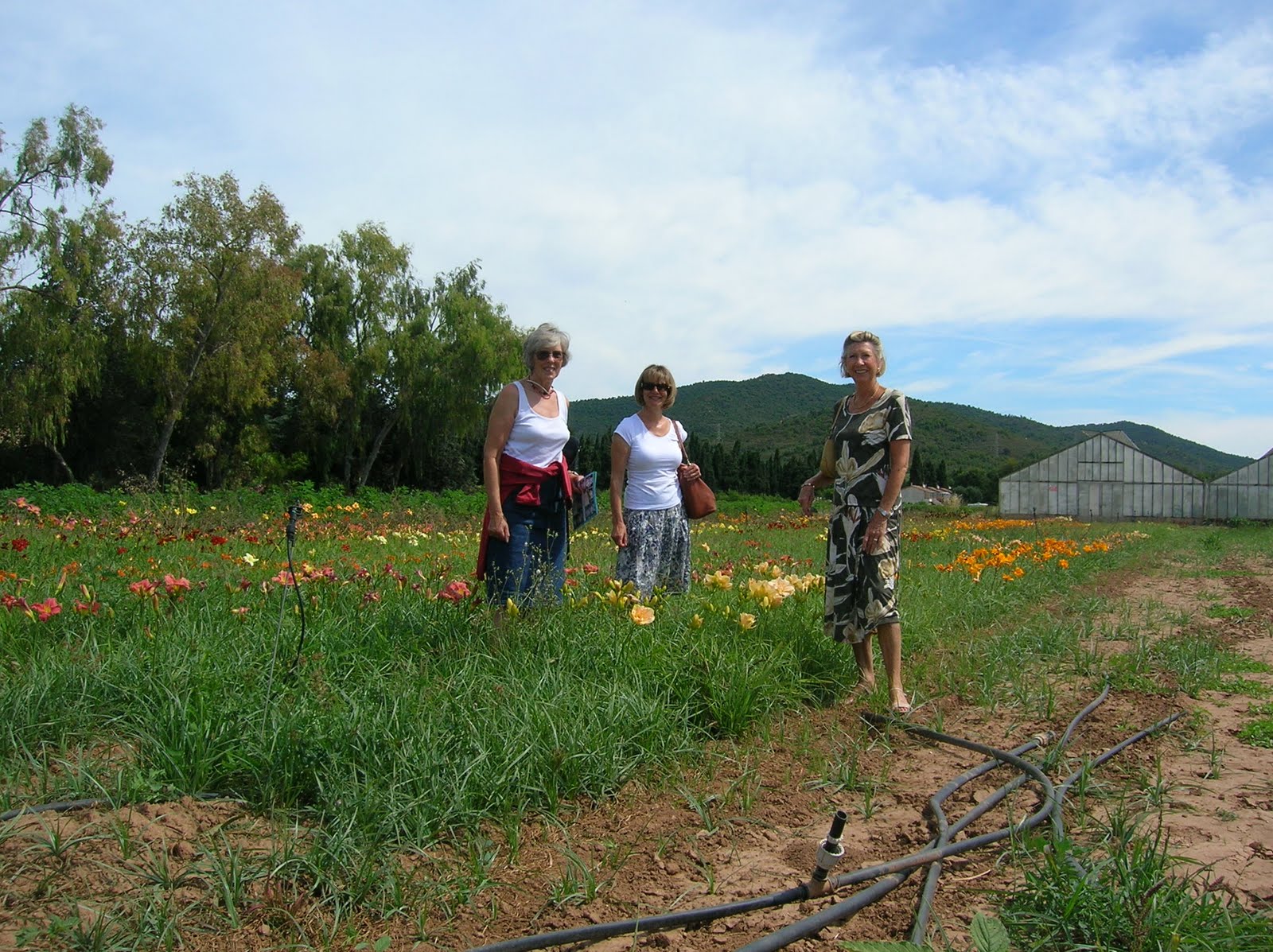
Visit to Iris En Provence to see the day lilies in flower.

Just four members (with no visitors to collect from the airport) made it to the peage carpark on Friday, 24th June, for the short journey to Iris En Provence, Hyeres to see the day lilies in flower. This is a small family-run professional nursery with iris and hermerocallis growing outdoors and various vegetable crops growing in plastic tunnels.


The day lilies were fighting for space with thistles and weeds and perhaps this was why they seemed smaller than the heights given in the brochure. It was also difficult to identify some of the varieties which did not seem to be listed in the catalogue and we discovered at the end of our visit that their website contains more varieties than the brochure! C'est la vie . . . . We were not tempted to buy any plants, many were not in flower and all looked rather uncared for and needed the dead leaves removing.


There are two basic groups of colours, the yellows and oranges or the reds and pinks, and my vote is to go for the evergreen varieties and those that flower more than once. I have also realised that in the hot sun of Provence the subtle blush pinks or pale creamy yellows are lost amongst other plants and need to be planted in a pot kept near the house in order to be seen close up.


At 11.45am we headed briskly to the town centre for the sacred two hours of lunch starting promptly at 12 noon, after which we allowed ourselves an inspection of what the shops had to offer. The centre of Hyeres is reasonably compact with some beautiful bourgeoise appartment buildings and tropical palm trees lining the streets. The dual carriageway approach to Hyeres from the A8 autoroute in June is a horticultural delight (eat your heart out, Promenade des Anglais, Nice!) with stunning mass planting of lantana, oleander, plumbago, perovskia, bourgainvillea - most of which we can't grow in Centre Var because of frost.


We rounded off our visit with a quick swim on the beach of the Presque Ile de Gien and afterwards located an even better beach backed by shady pine trees which we'll try on our next visit.


texte : Sue S


images : Elisabeth B


LinkWithin

Related Posts Plugin for WordPress, Blogger...